We are very proud to have supported The Ministry of Energy Zambia in its ambitious plans to create frameworks and policies to enhance private sector participation in the development of power projects in Zambia.
Alongside Kukula Capital (via Mphaso Banda), and Cities and Infrastructure for Growth Zambia (CIGZambia) team (Lorraine Ross, Chilombo Chila, Joseph Mutale, Michael Tarney, and Helga Wenhold, CCG (via Ginny Ip, Kirsty Mackinlay, Vivien Foster, Hannah Luscombe, William Collier, Ariane Millot, Leonhard Hofbauer and Raj P Bhavsar) have supported the Financing Roadmap for Zambia’s Integrated Resource Plan (which you can find here.)
The Plan’s Executive Summary says, “Zambia is advancing reforms to its market power while strengthening the resilience of its power system to climate change. The 2023 Integrated Resource Plan (IRP) outlines a least cost pathway to expand its power market to meet growing demand and transition toward a diversified energy mix. This includes reducing reliance on hydropower in southern Zambia, which is increasingly vulnerable to prolonged drought. The plan estimates a cumulative investment requirement of $11.6 billion by 2030, escalating to $31 billion by 2050. In parallel, the Open Access Framework (2025) shifts the market from a perceived Single Buyer Model toward a “willing buyer, willing seller” regime. This allows independent power producers (IPPs) to sign contracts directly with large energy customers, thereby expanding opportunities for private-sector investment.
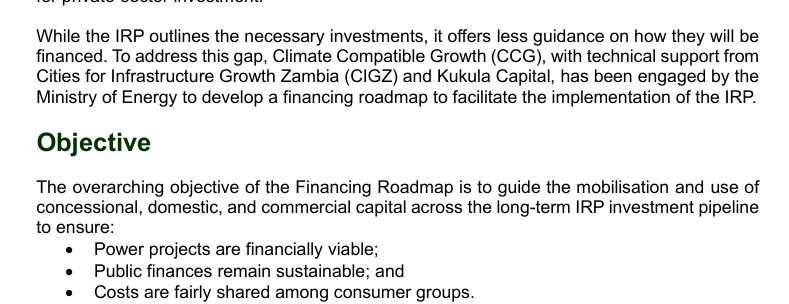
While the IRP outlines the necessary investments, it offers less guidance on how they will be financed. To address this gap, Climate Compatible Growth (CCG), with technical support from Cities for Infrastructure Growth Zambia (CIGZ) and Kukula Capital, has been engaged by the Ministry of Energy to develop a financing roadmap to facilitate the implementation of the IRP.
The overarching objective of the Financing Roadmap is to guide the mobilisation and use of concessional, domestic, and commercial capital across the long-term IRP investment pipeline to ensure Power projects are financially viable; Public finances remain sustainable; and Costs are fairly shared among consumer groups.
The analysis assesses the financial feasibility of the IRP at both the project and system levels and provides a practical roadmap for delivering it at scale.
System-wide feasibility: Examines total IRP financing needs relative to the cashflows projected sector cashflows. A ‘financing gap’ occurs when sectoral cash flows are insufficient to cover total financing requirements. Project-level feasibility: Examines IRP power project archetypes reflecting typical characteristics in Zambia to determine whether they can generate sufficient revenue to cover debt and provide reasonable returns to equity investors.”
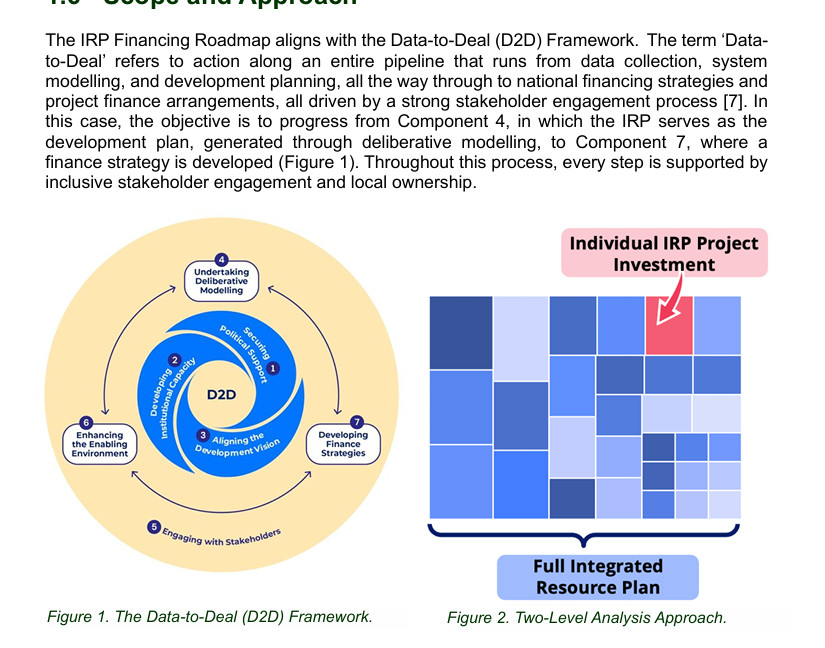
This is another real world example of the Data-to-Deal framework in action so we are delighted to celebrate that. If you’re interested in discussing it in relation to your own country, do get in touch.
The other strategic documents are: Competitive Procurement Framework for Private Sector investment in Renewable Energy (https://lnkd.in/eM_3TmWi) and Tax and Non-Tax Incentives Framework for Electricity Development in Zambia (https://lnkd.in/eGYa3-ph)