
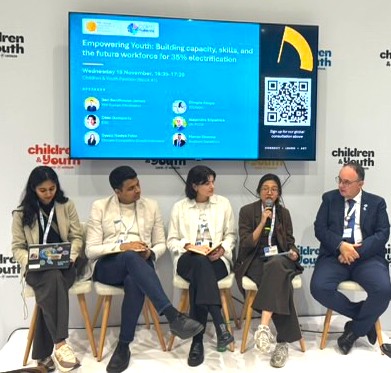
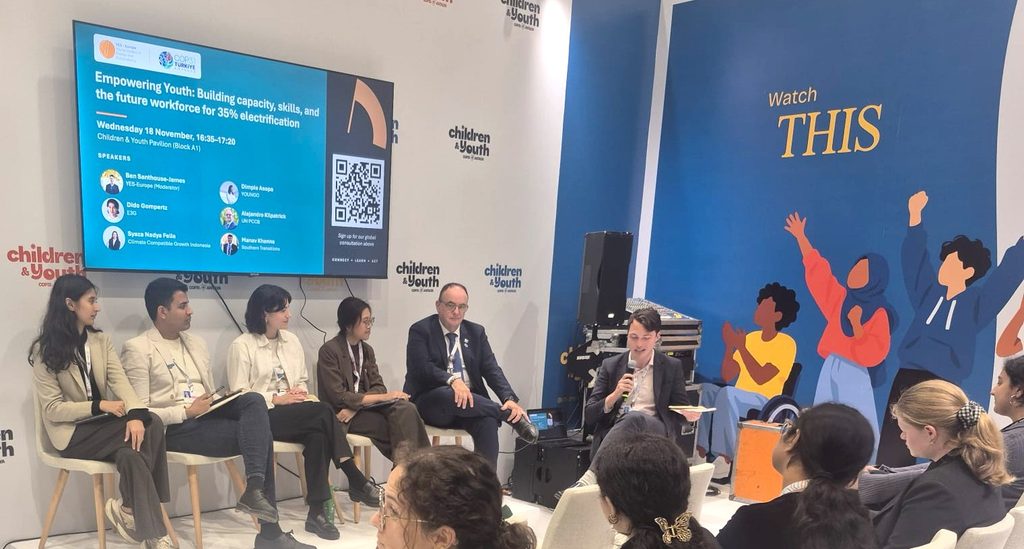
18 November, Youth Pavilion, Blue Zone Host: YES-Europe
CCG’s Nadya Felia was a Panellist
Other participants were:
Ben Santhouse-James, YES-Europe, Dimple Asopa, YOUNGO Manav Khanna, Southern Transition
Dido Gompertz, E3G Alejandro Kilpatrick, UN PCCB
The event opened with a brief introduction to the “35% by 35” electrification goal.
The moderator opened the discussion with the question: “What is your message to Parties for the remaining days of negotiations regarding firming up electrification ambitions?”
The youth panellists emphasized the need for clearer implementation pathways within the final decision text. Nadya noted that despite ongoing debates over the energy sources backing the electrification pledge, preserving the phrase “clean transition” in the draft—even if non-prescriptive—sends a strong policy signal, considering pushback from fossil-reliant nations.
Alejandro provided a senior perspective, agreeing with Nadya while highlighting the difficulty of inserting explicit clean-transition language, though noting it remains impressive that energy continues to be actively discussed in the decision draft.
The discussion then turned to workforce challenges: “Given that the grid workforce is under significant strain with scarce, highly demanded skills, how can we rapidly bridge this gap?”
Alejandro highlighted the shortage of specialized skills in renewable project deployment (eg solar technicians) across several regions and noted that UN PCCB is partnering with universities to cultivate academic researchers and technical experts.
Nadya underscored the demand for interdisciplinary talent, observing that educational models often segregate STEM and social sciences, whereas modern energy planning requires expertise spanning technical, political, and socio-economic domains.
To bridge immediate gaps, she stressed the value of targeted, credible training initiatives like CCG’s capacity-building programs, which foster long-term national expertise.
Nadya contrasted external technical assistance—which often leaves gaps once project teams depart—with CCG’s collaboration in Vietnam, where local capacity building enabled national energy planning to be handled internally and led to the creation of a dedicated master’s degree program. She reaffirmed the importance of aligning university programs with government workforce requirements.
Other youth panellists echoed these points, citing examples from India where skilled personnel exist but local market demand remains mismatched, reinforcing the need to address both skill supply and structural demand. There was also discussion on how to raise awareness in rural and underrepresented communities, noting the need for stronger NDCs and LTSs to give nations a better push to develop and mobilize necessary financing. Additionally, it was emphasized that youth training must be just and inclusive of these communities to build skills and literacy in parallel.
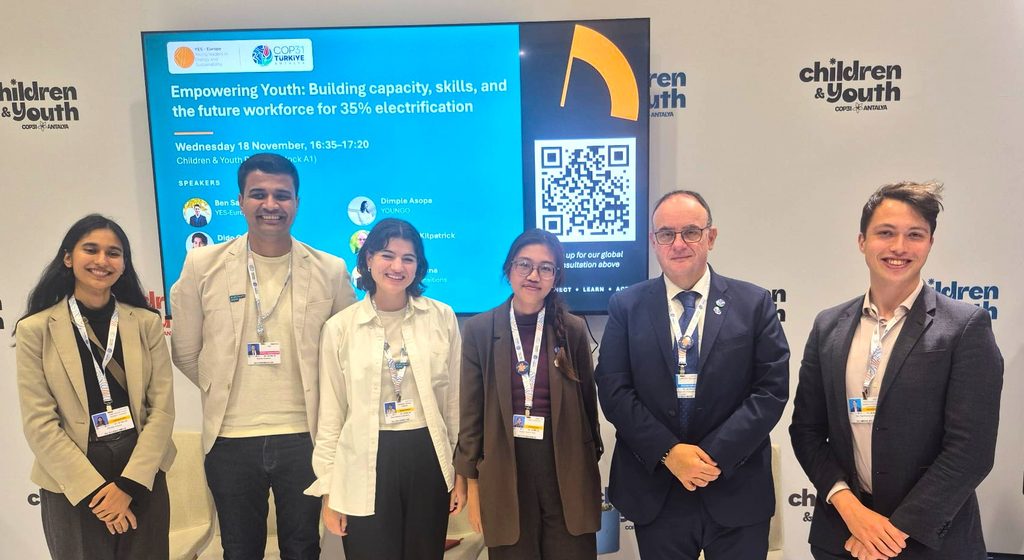
Dido Gompertz, E3G Nadya Felai CCG, Alejandro Kilpatrick, UN PCCB and Ben Santhouse-James, YES-Europe,