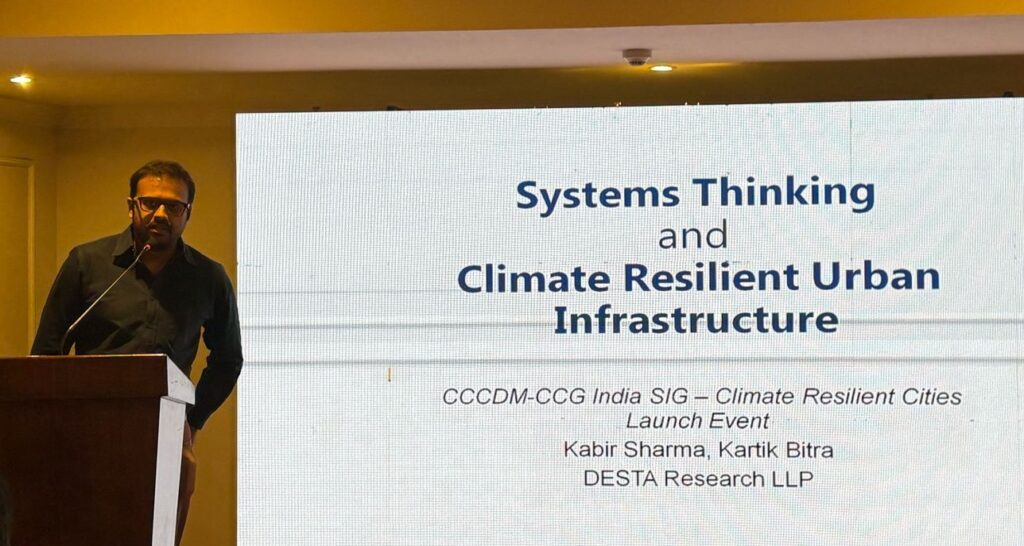
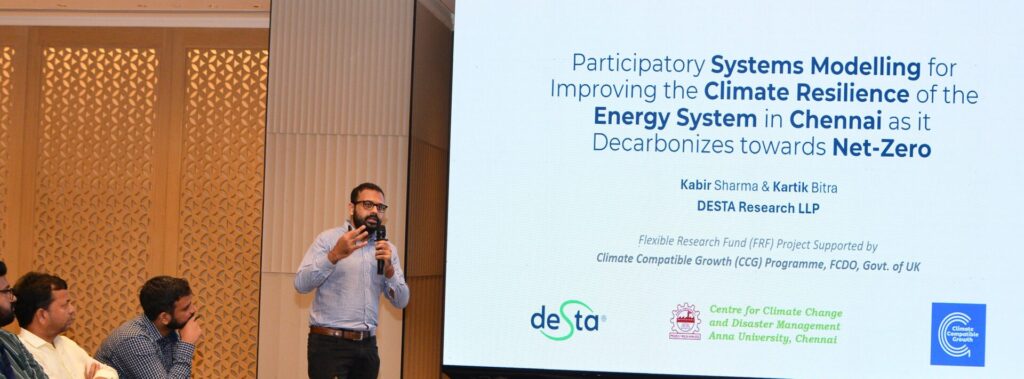
The FRF from CCG provides funding to enable researchers in our partner countries to undertake projects that might otherwise not be possible. Here Kabir Sharma (Founder – Director and Project PI) and Kartik Bitra (Research Associate and Project Manager) from DESTA Research LLP discuss their project.
What is the need that this project is responding to?
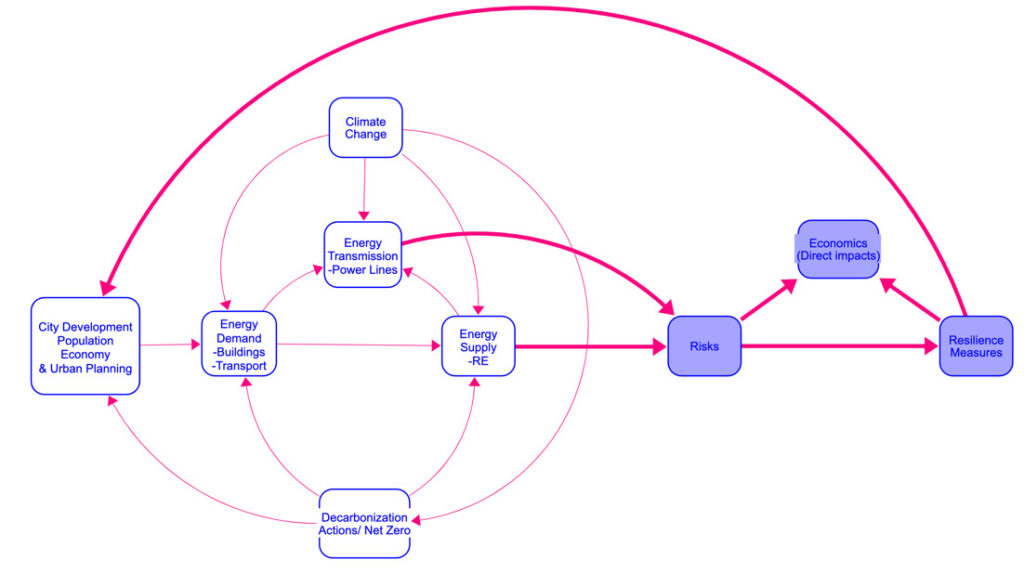
Kabir: In the Indian urban context, we expect a big increase in energy demand over the next few decades due growth in the economy as well as climate change coupled with a shift in energy supply towards high renewable energy penetration and increasing impacts of climate change. At the intersection of growing demand, increasingly variable supply and increased climate stress, there could be several risks which could emerge. The project is looking at mapping these risks using systems thinking, and quantifying the physical and economic impacts of these risks for one Indian city, Chennai.
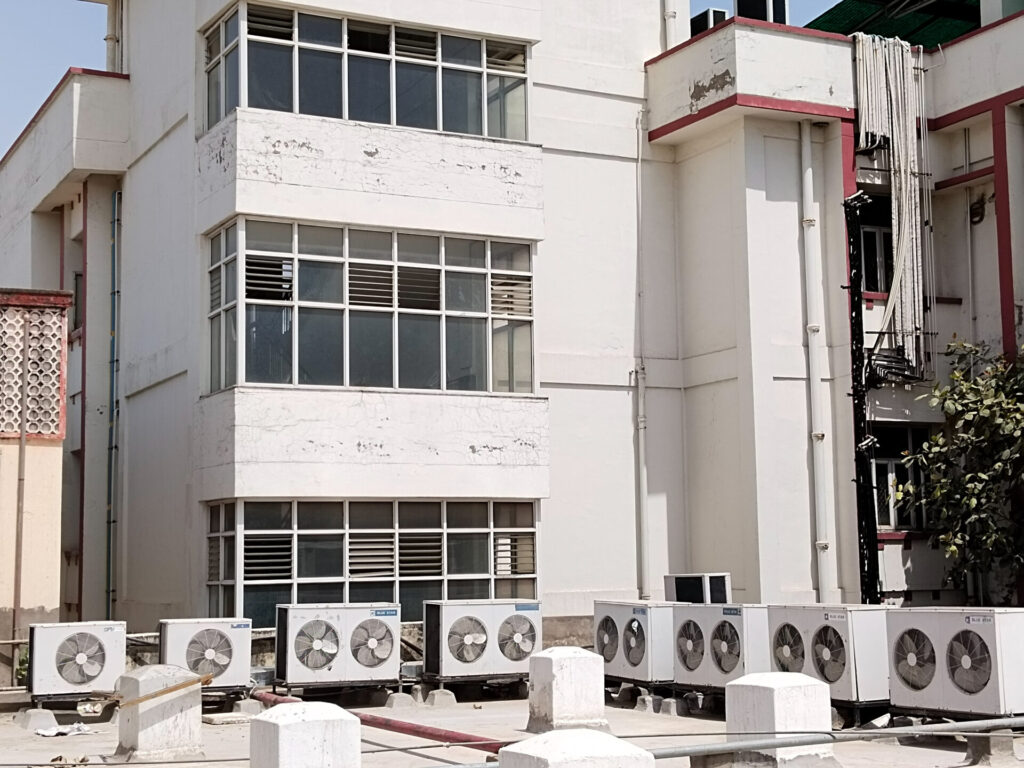
To elucidate this, we can look at a few pathways. So, because of the projected population and economic growth, we expect the energy demand to greatly increase. At the same time, we expect climate change and its impacts on cities to intensify in terms of heat stress, extreme rainfall, cyclones, increase in humidity, and so on. Some of these stresses will, and already are, manifesting in terms of even higher energy demand, due to for example increased cooling demand needs due to rising temperatures and heat waves.
Further, with the energy system itself decarbonizing rapidly, moving towards renewables and electric vehicles, there could be an even higher load for the electricity grid to deal with. India’s decarbonization is prioritising electrifying energy demand and greening the energy supply through renewable energy. But these clean renewable energy supply technologies are themselves prone to climate risks
And then, solar power and wind energy are directly exposed to the climate because they depend on it for production. So, if wind speeds change, or irradiance, or the temperature change, there could be risks on the production. And then, the Infrastructure itself could have risks, through climate extremes such as cyclones, that will affect supply. And many of these risks are relevant for the grid itself as well.
I understand; the clean energy infrastructure could get damaged.
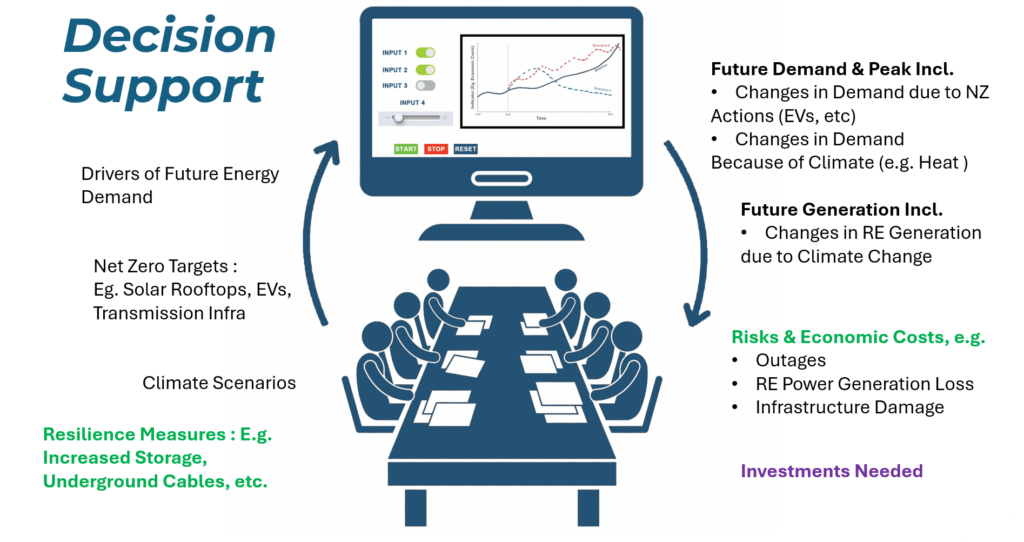
Exactly. On the demand side, we are expecting a big increase in energy use because of increasing heat stress, and the need for air-conditioning as one example. So, our project aims to scope out what these climate risks could be over the entire system – demand, supply, and transmission. We want to map these out using Systems Thinking, which is what we specialise in, while also getting inputs from stakeholders like government policy makers and people managing the grid to understand how they see this. Then we will use that information to create an insight-building system dynamics simulation model which can generate future scenarios up to 2050 to see, for example, what kind of infrastructure upgrades or changes in the demand side might be needed to reduce some of these risks. Kartik adds: We chose Chennai because in a previous project when we were working on Tamil Nadu, Chennai was one of the worst hit by climate shocks.
Tell me more about the model that you mentioned
We’re developing the model ourselves. DESTA’s specialisation is in Systems Thinking and in System Dynamics simulation modelling. So this will be a System Dynamics Simulation Model of the Energy System (Energy Demand and Supply ) for Chennai city which we are building.
Who is on your team?
From DESTA, there is myself, Kartik who is Project Manager and Research Associate; Prachi, who is Research Associate and Mihir, Co-Founder of DESTA and advisor to the project. We are partnering with the Centre for Climate Change and Disaster Management (CCCDM) at Anna University in Chennai who have their own in-house climate modelling tools. They are providing us with the climate change projections for Chennai and Tamil Nadu as well as helping us with the stakeholder engagement with the government. We also have Ms Suruchi Bhadwal, Director, Climate Change and Air Quality Division at TERI (The Energy and Resources Institute) based in Delhi. She is a climate expert and our advisor for this project. Finally, we have Mr Milind Ravindranath as another advisor. He is a grid modelling and transmission expert.
What is the project timescale?
It’s still ongoing. Initially we had envisaged 15 months for the entire project, but the elections this year meant that we’ve had to extend the timeline because we have not been able to interact sufficiently with government officers to obtain the data. So, the project will take about 20 months, until September.
You mentioned data, which is often a challenge for projects, what has been your experience in this case?
Yes, it’s been difficult, especially relating to the energy demand data and load profile of Chennai which is held by the government. There are a lot of procedures to go through that takes time. But we hope we will get more data in the next few months.
At this stage in the project, what has been the most interesting aspect for you?
One has been the validation and enrichment of the project’s hypothesis from the stakeholders themselves. Over the last few months, through our interactions, we have heard from the stakeholders – especially people managing the grid at the Tamil Nadu Electricity Board – that the huge penetration of air conditioners, of data centres, and of electric vehicles, is leading to a lot of demand side spikes, which are different from before. Also, on the supply side for renewable energy, because of changes in windspeed and variation in the intensity of the sun, there are challenges with grid management. It can also lead them to pay deviation settlement costs (penalties) whenever they have to procure power or produce extra power. They have validated the importance of this work with figuring out how climate change will impacting this entire system and our model could play a very useful role in helping mitigate some of these risks.
They also feel that more attention should go on the demand side in terms of encouraging energy efficiency and the time-of-use for appliances so the load can be spread more evenly. Looking into the future, they’re saying that we’re just starting with this decarbonization – we’re just about 20-30% there. It’s going to get a lot more variable on both demand and supply sides.
If the country is moving to clean energy and it needs to be consistently available, presumably you need some kind of backup if solar and wind are variable?
Right, and one of the big issues is energy storage. The model will show the numbers, but a storage system, both in terms of pumped hydro storage and then also lithium-ion storage (batteries) could store a lot of this extra power which is generated at times when the demand is lower and try to stabilise the grid when demand is higher or fluctuations happen. But it will also take a lot of changes on the demand side, such as charging our EVs during off-peak periods in order to manage the demand and supply balance
So, you might not need so much extra supply if you manage the existing supply better.
Exactly.
What about policy – who have you engaged with so far?
We have been engaging with the Tamil Nadu Electricity Board, which is a government-owned entity and our main stakeholder. We’ve also spoken to some of the urban government stakeholders because our project sits at this interface between urban governance and state. Generally, electricity is a state subject but there are also city-level risks, so we have had consultations with the Chennai Metropolitan Development Agency, which does planning for the city. The goal is to create this tool and then take it back to these policy and planning teams to do a live session with them using the simulation modelling tool.
We’re also in touch with an FCDO office, based in Chennai and the people working on climate and energy advisory… We hope to invite more government departments and officers to the final workshop so that we can make them aware of it.
How are the needs of marginalised communities reflected in your project?
We have been doing our work through that lens, and we have tried to map out some of the pathways which disproportionately impact marginalised people. But given that the project is focused more on infrastructure – at state level – it’s a bit of a challenge to factor that part in. But on the demand side of things, in terms of how energy is used, and by whom, we are bringing that perspective out in qualitative pathways and Systems Thinking. For example, the disproportionate impacts of climate which could happen to people who have less access to housing or women who stay home more and are exposed to urban heat.
That’s good news.
How important was the funding from the Flexible Research Fund for you with this project?
It’s been key to the project. When we did a smaller piece of work earlier on the impact of climate on renewables at the Tamil Nadu state level, a lot of stakeholders told us we were leaving out many facets of the energy system, like enetgy demand and transmission, so we wanted to do a more holistic analysis. We met the Anna University team who told us about the FRF call for proposals . This research would not have been possible without it. There’s also been a lot of support from our expert advisor, Dr Ragav Pant at the University of Oxford.
Kartik adds: Right now, we are working with the CMDA and the Tamil Nadu Electricity Board, but once the model is built, we will reach out to other departments.
Kabir From what we have heard so far, something like this has not been attempted till now. It’s a first of its kind where a model is trying to take inputs from stakeholders in the development of the model itself and looking at the entire energy picture: demand side, supply side, transmission, and looking at the climate impacts on it. A lot of current energy planning does not fully consider some of the climate impacts; some studies have done it piecemeal, but to our knowledge , nobody has done it all together for one geographical location to see how it all comes together.
Once we have developed the model, we hope to put it out for the public good as a model to be used. The assumptions, equations will made public so people can also use the model. There is also potential for making such models for different cities once this is completed.