
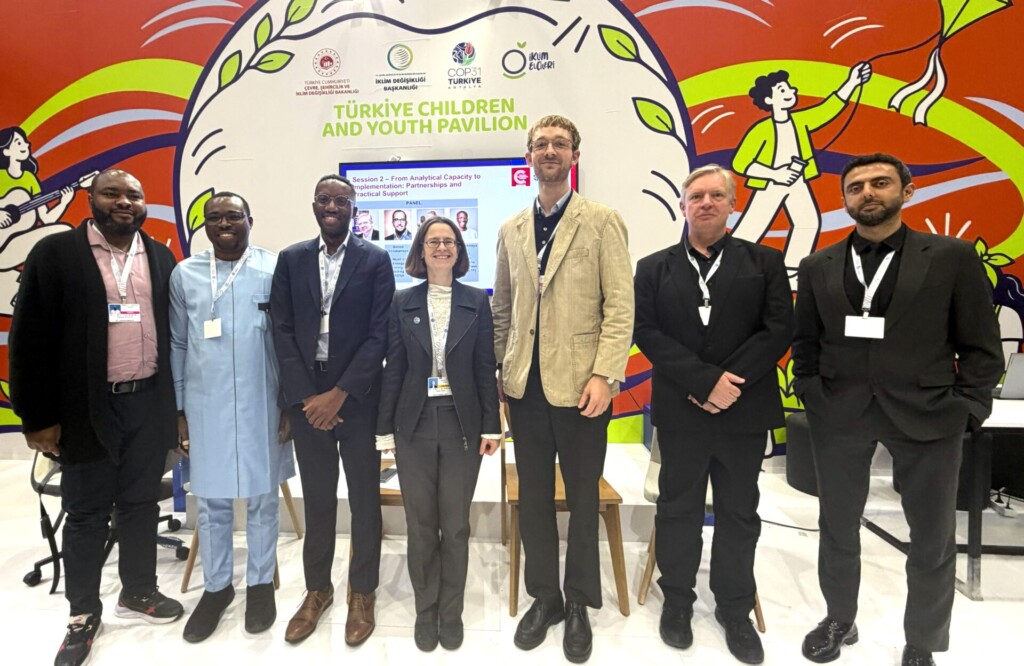
Date: Wednesday, 11 November, 15.15-16:15, Location: Youth Pavilion, Blue Zone
Opening Remarks | Prof Mark Howells, Director of CCG
Mark described CCG’s objective as supporting economic growth while reducing emissions, and highlighted scientific collaboration and cooperation between institutions as central to achieving both goals.
He explained that CCG works with governments and universities in different countries to develop data and analytical tools that governments can use in their own planning. This work links directly to mobilising finance. By bringing different institutions into the process, governments can use the evidence to explore options, decide which to pursue, and identify where finance could help put those choices into practice.
Mark highlighted the importance of the COP31 Presidency’s presence at this event and acknowledged Türkiye’s role in helping reach out to other countries. Reflecting on the spirit of the partnership, Mark concluded by saying that an institution can move quickly on its own but working together gives partners a way to move quickly and go further.
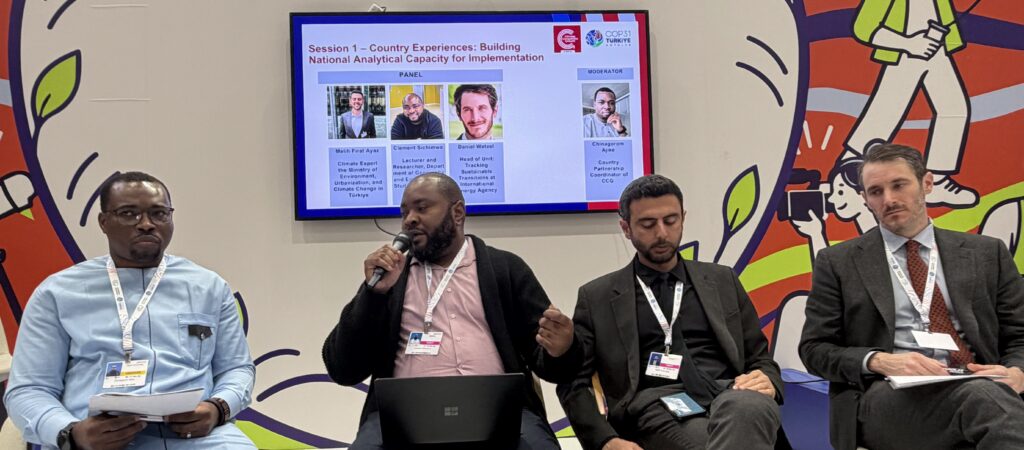
Session 1 – Country Experiences: Building National Analytical Capacity for Implementation
Panellists
- Melih Fırat Ayaz — Climate Expert, Climate Change Mitigation Department, Türkiye’s Ministry of Environment, Urbanization and Climate Change.
- Clement Sichimwa — Lecturer and Researcher, Department of Geography and Environmental Studies, University of Zambia.
- Daniel Wetzel — Head of the Tracking Sustainable Transitions Unit, International Energy Agency (IEA).
Clement identified institutionalising analytical capacity as one of Zambia’s biggest challenges. Even when modelling tools are accessible, national institutions need people who can use them routinely and apply the results to policy decisions. He pointed to the establishment of a centre for climate research as one of the most important steps taken to build that capacity.
Melih described Türkiye’s efforts to build a stronger analytical basis for climate policymaking, including for the design of market interventions. He explained that Türkiye had developed a climate mitigation action plan that became the main instrument for implementing its Nationally Determined Contribution (NDC). He stressed that national ownership of the analytical tools was critical to this work.
Daniel highlighted the importance of establishing benchmarks so that teams can assess whether a project or policy is working. He also stressed the need to identify data gaps and check how well available data reflect conditions on the ground. Drawing on an example from Africa, he recalled instances where the data did not match what teams observed in practice.
What makes evidence useful to decision-makers?
Asked which forms of evidence are most useful, Clement said policymakers engage more readily when analysis starts with real problems they recognise. This as a process of co-creation; when policymakers help shape the analysis, they are more likely to take ownership of its findings.
From a government perspective, Melih explained that senior decision-makers want to see what technical results mean for income and public budgets, as well as what would be required to implement a proposed measure. He emphasised the value of a clear summary that sets out the potential impacts, financing implications, implementation requirements and budget effects of each option.
Daniel said that starting with the biggest problems can help capture decision-makers’ attention. He stressed that modelling should be designed around the questions decision-makers are trying to answer, so the results can inform the choices they face.
Sustaining expertise and broadening ownership
Clement called for involving young people in policymaking because they will become the next generation of modellers. He also saw a role for external consultants in supporting the development of national expertise.
Melih said Türkiye had worked with CCG for two years and that the national team had learned a great deal from CCG’s experts. He highlighted the value of using a model designed around Türkiye’s needs and social context, with coverage of emissions across all major mitigation sectors. He stressed that the national team needs deep technical expertise of its own so it can explain the assumptions behind the analysis and defend its findings. He also called for involving all relevant actors while policy is being developed, so that ownership extends across the institutions and stakeholders involved. He identified broader participation at that stage as an area Türkiye wants to improve.
Daniel encouraged teams to build networks of experts they trust. Energy analysis can call for deep expertise across fields as varied as satellite data and geopolitics. A trusted network gives teams people to turn to when a policy question requires knowledge beyond their own specialism.
Data-to-Deal and MOSAIC – Mark Howells
From least-cost pathways to financeable investments. Mark drew on CCG’s work with Türkiye to explain what the Data-to-Deal (D2D) approach can help governments do. A least-cost energy system model can identify what capacity to build and how to dispatch it. Mark explained that a pathway that looks least-cost in the model can still be difficult to finance. Under D2D, teams stress-test the pathway against affordability, risk premiums and limits on available capital. They then feed those constraints back into the model and revise its assumptions. The aim is to identify investments that governments and market actors can realistically finance. Mark said this process should be led by energy planners.
Adapting OSeMOSYS to national needs. Mark described how teams had adapted the Open Source Energy Modelling System (OSeMOSYS) for Türkiye and other country applications by selecting and modifying components to suit each case. The open, human-readable equations provide a common mathematical foundation for national planning. Starter Data Kits supply baseline country inputs, while the MUIO no-code interface makes it easier for new users to build models and get started. The slides also described AI-assisted workflows designed to operate under expert oversight.
Combining tools and datasets through MOSAIC. Howells used a prism visual to illustrate how components from different teams could be brought together in a single modelling workflow. He introduced MOSAIC as modular public-good infrastructure for teams that use different models, tools and datasets. Its components can be used independently or combined, including Starter Data Kits, the MUIO interface, the Rust-based MOSOX compiler and external tools such as third-party solvers and geographic information systems (GIS). The emerging MOJITO interoperability layer is intended to extract, translate and interpret data across modelling environments, including OSeMOSYS and national kits, frameworks such as MESSAGE, TIMES and PyPSA, and applications that institutions build for their own needs. Howells also described the goal of letting modellers express equations directly in familiar mathematical notation, reducing the need to learn a particular coding syntax.
Comparing models on a common basis. Mark introduced Revendallt, a shared dataset and benchmark for comparing six power system modelling tools: OSeMOSYS, EPM, MESSAGE, TIMES, PyPSA and FlexTool. The benchmark covers flexibility, intermittency, storage across different durations, and transmission and distribution constraints. He also noted a developing research collaboration with MIT. Separately, the presentation reported up to 6.5× faster matrix compilation in OSeMOSYS tests using the MOSOX compiler. Testing is under way for next-generation MESSAGE, benchmarking is still needed to assess potential gains for IRENA’s FlexTool, and TIMES developers are considering pilot testing.
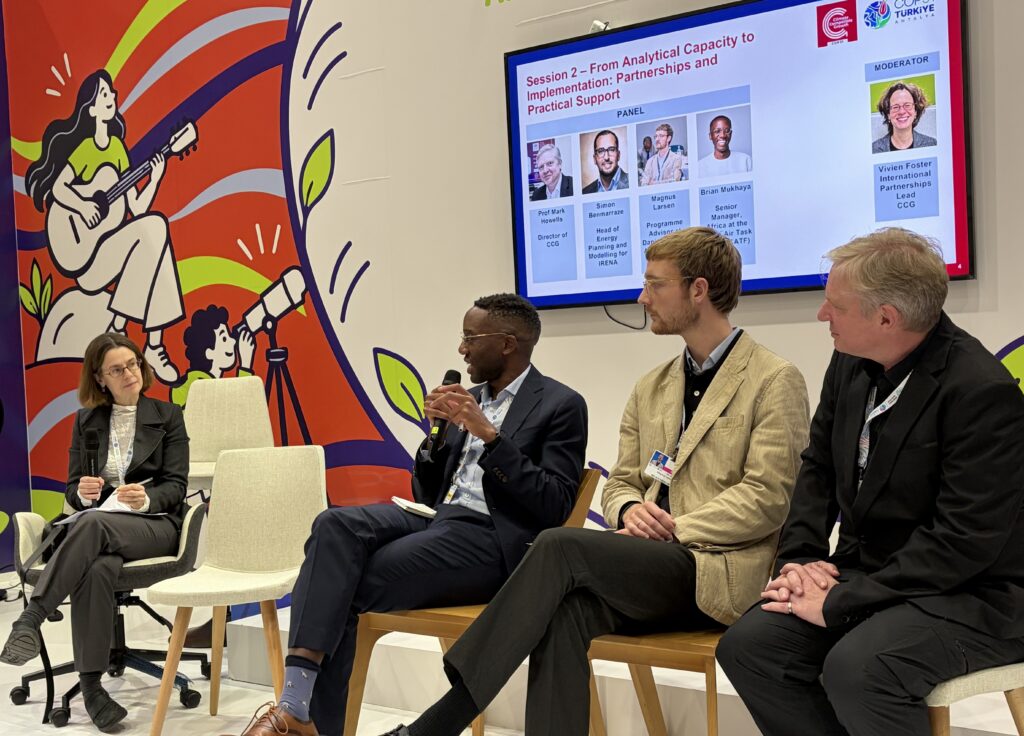
Session 2 – From Analytical Capacity to Implementation: Partnerships and Practical Support
Panellists
- Brian Mukhaya — Senior Manager, Africa, Clean Air Task Force (CATF)
- Prof Mark Howells — Director, Climate Compatible Growth (CCG)
- Magnus Larsen — Danish Energy Agency (DEA)
- Simon Benmarraze – Senior Manager, International Renewable Energy Agency (IRENA)
Brian Mukhaya highlighted MOSAIC’s potential to help teams reach results faster by making it easier to access and work with different modelling tools. He linked that practical benefit to the discussion on institutional development. Easier access to tools can support institutions as they build their own capacity to carry out energy planning.
Simon Benmarraze drew on IRENA’s experience of working through international energy planning partnerships. He described a landscape with many tools and organisations, where it can be difficult to see how separate efforts fit together and coordinate the support countries receive. He stressed that teams need to understand the background of each tool, including what it was designed to do and the assumptions it relies on. Building that understanding across institutions and modelling teams is one of the challenges MOSAIC will have to address.
Mark Howells explained that AI can make it easier to run several modelling tools. This can speed up analysis, while making it harder for users to follow what happened at each step and take ownership of the results. He suggested breaking a project into smaller parts so teams can work through the analysis and understand how the outputs were produced. He also stressed the importance of being able to speak with a person when questions arise about an AI-assisted workflow.
Mark cautioned that trying to develop a single standard that meets everyone’s needs can create problems. Magnus Larsen said standardisation can improve consistency and transparency, while warning that it can oversimplify real planning challenges. He added that what can usefully be standardised may vary from country to country.
Drawing on the African context, Brian pointed to the advantages of standardisation while emphasising that a model’s usefulness depends on where and how it is applied. A model can be well suited to one planning question and give misleading results in another. The resolution at which the model represents the system is one factor in whether it can answer the question at hand.
The discussion closed with appreciation for MOSAIC’s potential to make modelling tools easier to use together.