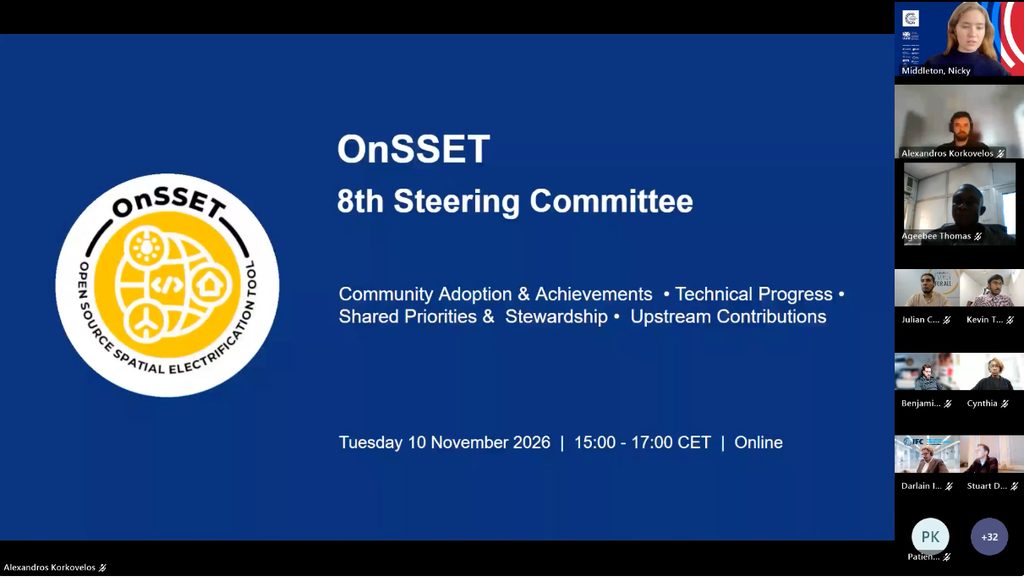
On 10 November 2026, the OnSSET community came together for its 8th Steering Committee to share new developments, implementations and studies. We were joined by over 50 participants from around the world, with the session facilitated by Andreas Sahlberg and Alexandros Korkovelos (SEforALL) alongside Nicky Middleton (CCG).
With fewer than five years left to deliver SDG7, the momentum behind energy access is building. Mission 300, led by the World Bank and the African Development Bank, aims to connect 300 million people in Africa to electricity by 2030. At COP31 the World Bank launched the Electrify Now Finance Coalition to help mobilise finance across emerging and developing economies. Commitments on this scale need a clear answer to where, how and at what cost to electrify, and that is the question OnSSET was made for.
The Open Source Spatial Electrification Tool (OnSSET) was built to find the least-cost way to bring electricity to every settlement in a region. This year’s meeting showed just how far the community has taken it: into government-owned national plans, new links with other models, and even AI-powered tools that let anyone explore results in plain language.
We opened by mapping who uses OnSSET and how. Nearly half the room came from academia (47%), with strong representation from government (18%) and NGOs (15%), as well as the private sector (8%) and other organisations (12%). Participants are active across the whole OnSSET ecosystem, from developing the model to running analyses, publishing reports and delivering training.
OnSSET in action
National plans owned by governments
One of the most encouraging trends is governments taking ownership of the analysis themselves. Just days before the meeting, Mozambique’s Ministry of Mineral Resources and Energy launched its least-cost electrification plan alongside an open-access Integrated Energy Planning Platform. Developed over two and a half years with support from SEforALL, the World Bank and partners, the plan goes well beyond household connections. It integrates clean cooking, social facilities and productive uses of electricity, and supports Mozambique’s Mission 300 compact goal of universal access by 2030.
In Nigeria, Thomas Ageebee of the Energy Commission of Nigeria shared how a new national steering committee on energy modelling is bringing ministries, departments and agencies together. It is tackling institutional silos, building trust and closing data gaps, with OnSSET already supporting subnational studies in Kaduna and Sokoto states.
OnSSET has also informed national electrification strategies in Senegal (IRENA), Sierra Leone and Madagascar (VIDA) this year. In the Amazon, a group of universities is building a multi-country subnational planning platform.
Connecting OnSSET with other models
The community is increasingly linking OnSSET with other tools, placing electrification within the bigger picture of energy system planning:
- Generation and transmission: Corrado Caminiti (Politecnico di Milano, University of Pisa and KTH) presented an iterative soft link between OnSSET and PyPSA, tested on Uganda. The code and Uganda test data are openly available on GitHub.
- Clean cooking and agriculture: SEforALL has linked OnSSET with OnStove in Mozambique, and with AgCap in Mozambique and Madagascar.
- Power system planning: IRENA has linked OnSSET with SPLAT, and SEforALL with SEM in Sierra Leone and Myanmar.
- Biomass: Abdulateef Gafar (University of British Columbia) presented two innovative methods for identifying where biomass-powered mini-grids can compete, combining OnSSET costs with crop production and land cover data. Stuart James (TU Munich / Deggendorf) is bringing biomass into a hybrid mini-grid optimisation for Botswana, with early results identifying around 20 settlements well suited to PV-biomass or PV-diesel hybrids.
Putting results in the hands of decision-makers
Some of the most exciting work this year focuses on turning model outputs into tools planners can use straight away:
- OnSSET Planning Pack (IRENA): a browser-based suite of modules developed through IRENA’s work in Senegal. It ranks settlements within a budget, converts results into a year-by-year rollout aligned with budget cycles, and generates briefing reports in English and French, with no programming required. It will be released on GitHub by the end of the year.
- Energy Access Explorer: Frederic Famba brought OnSSET results into the Energy Access Explorer for Kinshasa and Butembo in the DRC, at 1 km² resolution. A training in Kinshasa brought together 15 people from government, academia, utilities and civil society, and universities are now asking to include it in their teaching.
- ChatOnSSET: Kevin Theivendran, during an internship with SEforALL, built a prototype chatbot that answers plain-language questions about OnSSET scenario results.
- OnSSET MCP: Corrado Caminiti has also built a Model Context Protocol server that lets any large language model run OnSSET simulations, sensitivity analyses and scenario comparisons from simple prompts, with no Python knowledge needed.
Research and training going from strength to strength
OnSSET now features in around 40 peer-reviewed papers. 2025 was a record year with 8 publications, and 2026 already has 5, with more under review. Excitingly, a growing share of this research comes from authors outside KTH, where the tool began. At least 13 MSc and 4 PhD theses have used OnSSET, and it has informed major reports including Tracking SDG7 and SEforALL’s Beyond the 100% Assumption.
Capacity building continues to grow too. Through the Energy Modelling Platforms run by CCG, SEforALL and partners, more than 200 people from over 40 countries have now been trained in OnSSET, and more than 10 trainers have come through the programme. The new EMP-X phase is supporting national institutions to run their own trainings, with events in Ethiopia and Zambia this year and Nigeria coming up next.
Looking ahead
The second half of the meeting focused on where OnSSET goes next. Participants shared ideas for new features and voted on their priorities for the next 12 months. The ideas fell into four themes:
- Model realism: electrical network modelling, installation and logistics costs, system-size costing and climate resilience.
- Scope: more generation technologies such as mesh grids, identifying existing solar home systems, and richer sectoral and building-level demand.
- Accessibility: documentation in more languages and more user-friendly interfaces.
- Integration: multi-criteria analysis, interoperability with other tools, and links to financing.
These votes give the team a clear signal from the community. We’ll now bring them together with the existing development priorities on the OnSSET Forum and share a draft roadmap that is ambitious but realistic to deliver.
Building OnSSET’s next chapter together
As OnSSET’s reach grows across governments, universities and international agencies, there is a real opportunity to grow the community that sustains it. Much of the shared code is still maintained by a small, dedicated group, often alongside their other work.
There are three great ways to contribute back:
- Code: fix bugs, submit features, test releases and review pull requests on GitHub.
- Knowledge: document workflows, share reusable examples and help other users on the OnSSET Forum.
- Resources: fund developer time, maintenance, shared infrastructure and training events.
Every contribution counts. Many of the extensions showcased this year, from the PyPSA link to the biomass work, could become part of the core tool and benefit the whole community.
Get involved
A huge thank you to everyone who presented, voted and shared their work, and to SEforALL and KTH for co-organising. Attendees will receive the recording, transcript and updated presentation, including the full list of applications and partners.
If you’re using OnSSET, we’d love to hear about it, whether it’s a published paper or policy work such as a national plan or energy compact. Here’s how to get involved:
- Join the conversation on the OnSSET Forum, part of the CCG energy modelling community
- Explore the code on GitHub and the documentation
- Download baseline data from the OnSSET Starter Data Kit
- Take the free, self-paced OnSSET course with the Open University
- Tag OnSSET on LinkedIn when you share new work
And watch this space: a new OnSSET website, bringing the software, documentation and community together in one place, is coming soon.