This event took place on 9 November 2026 and was co-organised by Fika, International Road Federation (IRF) – Official Account and SLOCAT Partnership on Sustainable, Low Carbon Transport. Our colleague Holger Dalkmann took part in the panel and group discussions.
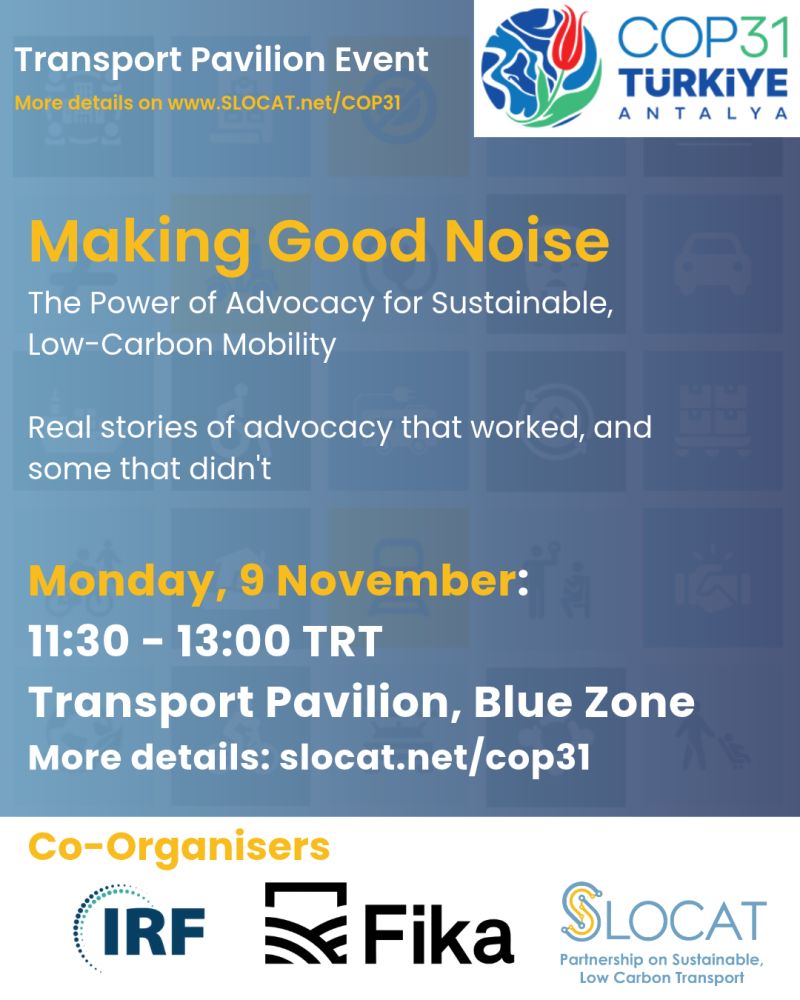
On the panel, moderated by Jill Warren, were Eniola Mafe-Abaga Senior Advocacy and Partnerships Director of Fika, with Alice Yiu Head of Advocacy and Outreach at International Road Federation (IRF) – Official Account, Pamela Mercedes Abreu Toribio Head of Mitigation Department, National Council for Climate Change, Dominican Republic (Cambio Climático RD) and Holger Dalkmann Transport Team Lead at Climate Compatible Growth. Jim Walker from Walk 21 and Philip Turner from UITP also joined the event.
Advocacy is most effective when evidence and pilot projects directly align with government development priorities and national budgets, leading to long-term government ownership (eg Ethiopia’s rural bridge investments). FICA emphasized how demonstrating bridge-building in Ethiopia using sweat equity and philanthropic funding paved the way for alignment with a 300-400 million USD World Bank food security programme and secured 15 million USD in direct government cost-sharing across five regions.
This work is now expanding into a master plan to build 393 bridges across multiple regions by 2030 under Ethiopia’s national development plan, demonstrating how pilot demonstration projects can scale into fully owned government priorities. She also stressed that rural transport infrastructure advocacy must focus on return on investment and universal access metrics to effectively meet government priorities.
Holger reflected on the evolution of transport at COP since 2006, highlighting the 2012 Rio+20 landmark where eight Multilateral Development Banks committed $175 billion to sustainable transport. He attributed successful advocacy to the “Four C’s” (Courage, Commitment, Community, and Continuity) and called for multi-year funding support, open-access transport data, and streamlined climate finance frameworks.
Holger’s response on “what is one important advocacy outcome you would like to see, here at COP or otherwise, that would help accelerate global action and investment in sustainable transport?” was: First, strong commitments following up on transport declarations from last year. Second, expanding initiatives for open access to transport data. Third, scaling finance frameworks for climate-compatible transport to streamline projects with development banks.
Climate Compatible Growth has successfully worked on a framework called Data-to-Deal for the last five years, which led to better data, better modeling, better community involvement, and enabled the government to work closely with banks.

Jim Walker, Strategic Director at Walk 21 highlighted the pandemic awakening around active mobility and the creation of PATH (Partnership for Active Travel and Health), which united around 300 walking and cycling organizations globally to establish a unified voice at COP. By creating practical, “copy-and-paste” policy guidance templates and baseline evidence, the coalition successfully helped an extra 40 countries incorporate walking and cycling into their Nationally Determined Contributions (NDCs) over three years, bringing the total to a third of all countries with a goal of reaching 50% by 2030. He cautioned against simply pushing step counts or treating walking solely as a necessity, urging the global community to focus instead on improving the quality of experience, comfort, and safety during this UN decade of action.
Philip Turner from the International Association of Public Transport (UITP) drew on his background as a UK government negotiator and his time at Transport for London to illustrate that successful advocacy requires proactive facilitation and practical evidence rather than just demands. He shared an example where taking a policy advisor on site visits across underground and overground stations demonstrated firsthand why a proposed carbon reduction legislation was unworkable, successfully leading to a change in the policy. He emphasized that inconsistent messaging can harm advocacy efforts, making united platforms like SLOCAT essential, and noted that UITP’s 2,000 member organizations are actively working to help countries deliver on public transport and NDC targets.