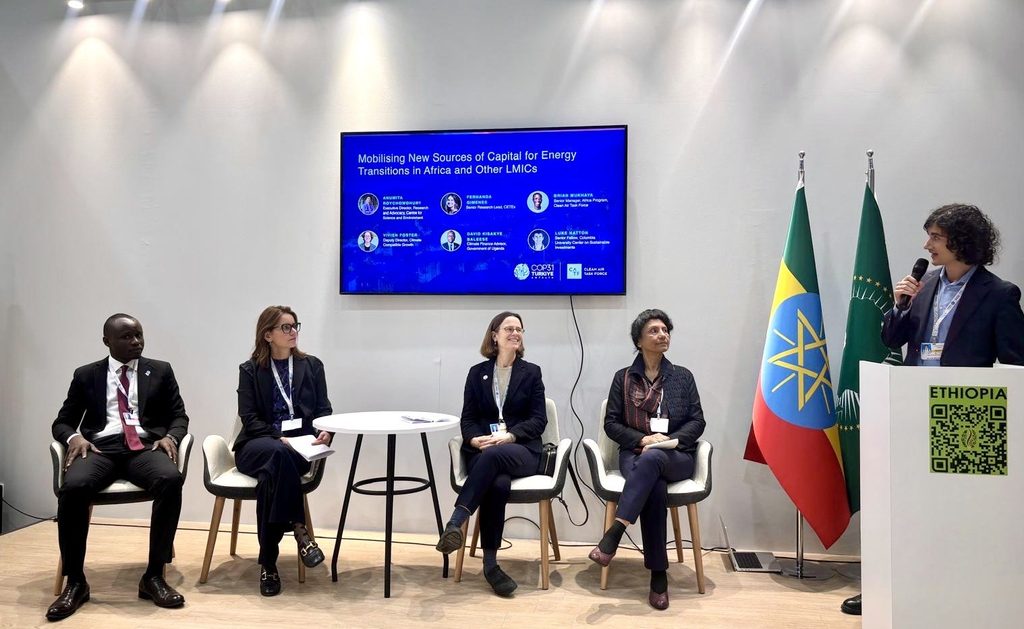
Mobilising new sources of capital is essential to accelerating clean energy transitions in Africa and other low- and middle-income countries. But despite growing investment needs, declining development finance, high borrowing costs, and geopolitical uncertainty continue to constrain progress. On 10 November at COP31 Clean Air Task Forces’s Brian Mukhaya hosted a discussion at the Ethiopia Pavilion on overcoming these financing barriers, strengthening cross-regional collaboration, and advancing climate finance priorities for energy transitions. Speakers were: Fernanda Gimenes (Centre for Economic Transition Expertise, LSE), Vivien Foster (CCG), Anumita Roychowdhury (Centre for Science and Environment), David Kibakye Baleese (Ministry of Finance, Government of Uganda), Luke Hatton (Imperial College London)
Summary:
Despite growing investment needs, declining development finance, high borrowing costs, and geopolitical uncertainty continue to constrain progress on mobilising capital towards clean energy transitions in African and other LMICs.
This panel discussion brought together a diverse set of speakers to reflect on challenges, best practice and emerging innovative solutions to scale energy investment flows into LMICs to the levels required to deliver on climate and development goals.
This serves as a valuable starting point for the “Road to Addis” for COP32 next year, where the focus will be on translating climate finance pledges into concrete delivery.
Key takeaways:
- Country contexts matter: Treating all LMICs as the same conflates unique issues facing the development and financing of country transition plans, with substantial differences between the BRICs, other middle income countries and low-income countries.
- Tradeoffs between equity and efficiency: private capital is easiest to mobilise in the BRICs and MICs, with more technical assistance and concessional financing needed to scale financing to low-income countries which have contributed the least to climate change, but are some of the most exposed to its impacts
- Catalytic role of public interventions: examples from Uganda and India of using public organisations as intermediaries to reduce the risks of late or delayed payments from offtakers were highlighted, whilst the success of the EcoInvest programme in Brazil in addressing currency risks and attracting international financing was discussed.
- The role of credit ratings: concerns were raised around existing credit rating methodologies and whether they accurately represent the real risks facing infrastructure projects in LMICs, with performance data from sources like the Global Emerging Markets Risk Database highlighted as key to addressing these issues.
- Institutions and governance: cross-ministry collaboration and locally-led development of transition plans are integral to successful mobilisation of climate finance, with CCG’s work in Zambia supporting the Financing Roadmap discussed as a successful example of building local capacity and co-ordinating across ministries.