

Friday, 13 November, 11.00-12:30. Transport Pavilion, Blue Zone
Host: National Council for Climate Change and Carbon Markets, Dominican Republic (Presidency of the Declaration). CCG’s Holger Dalkmann was the Keynote Speaker.
Jill Waren, from SLOCAT made the opening remarks . She noted that it had been one year since eleven countries endorsed the Ministerial Declaration on low-emission and resilient transport at COP30 in Belém. She welcomed the coalition’s expansion, with Bolivia, Grenada and Panama joining at COP31. She thanked the partners supporting the initiative. Representatives from par-ticipating countries then gave brief remarks. Leslie Dave Smith from Grenada noted that transport accounts for 32% of its emissions. He welcomed Grenada’s participation in the declaration as part of its efforts to reduce transport emissions.
The SLOCAT representative highlighted the work governments had done to advance the Global Transport Effort between 2025 and 2026. Governments initiated the effort and continue to lead it, as country ownership is central to this approach. As a multistakeholder partnership, SLOCAT supports that government-led work in four areas:
- Resources — Help governments access and mobilise funding.
- Data and evidence — Track progress using data and evidence.
- Communication — Share progress internationally.
- Connections — Connect governments with the institutions that can provide support when needed.
Stefan Mager, Head of Infrastructure at e-MOTION (GIZ) said that transport is the second-largest source of emissions and highlighted three reasons why the declaration matters to GIZ. Quantified targets make it easier to track progress transparently, and looking at transport as a whole helps countries build more resilient systems. On finance, Mager highlighted the value of a strong evidence base for investment decisions. He also explained how e-MOTION, a regional initiative to decarbonise transport, supports the declaration in practice by assisting the secretariat, helping track progress and maintaining coordination among participating countries.
Panel discussion
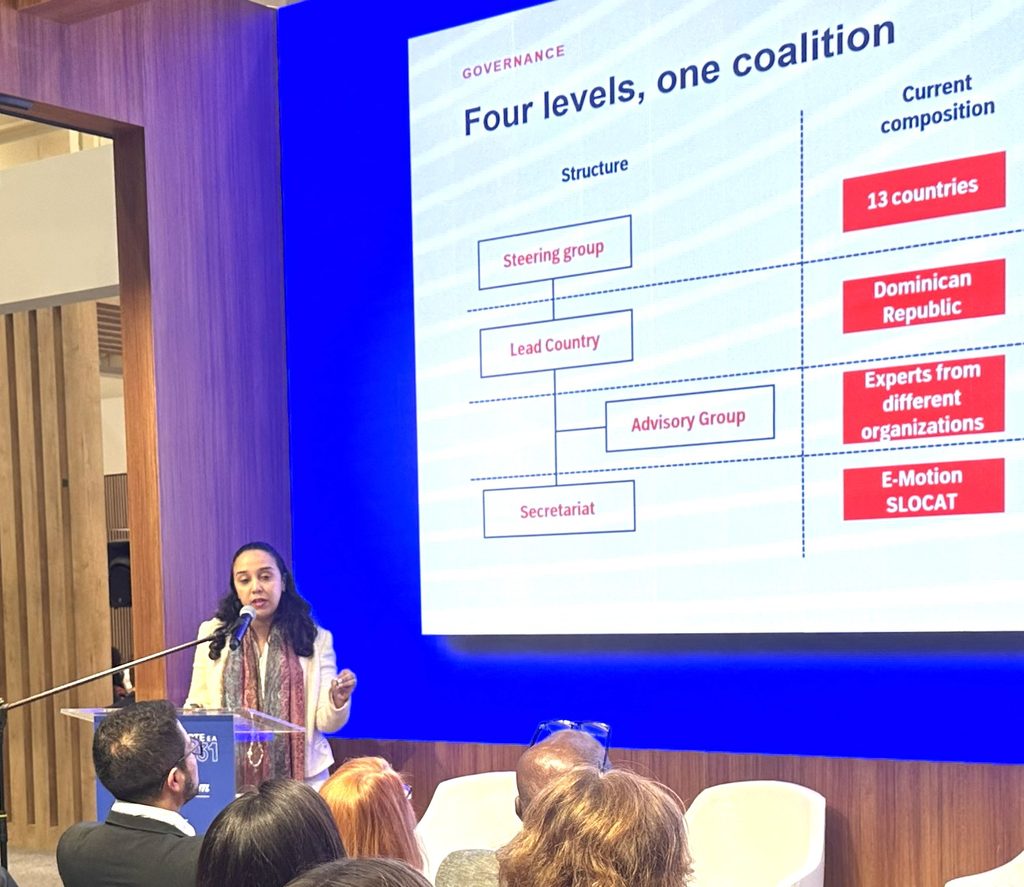
Pamela Abreu — Dominican Republic. Marking the declaration’s first anniversary, Pamela Abreu welcomed the addition of new members. She explained why the Dominican Republic had backed a global effort. Transport is the country’s second-largest source of emissions, after electricity generation, and the country already had a national vision for the sector. COP30 provided an opportunity to bring that work into a shared international effort. She also highlighted resilient access to energy as a national priority.
The main lesson from the first year was that governments can become so focused on their own targets that they miss opportunities to learn from one another. The declaration is a way for countries to consult each other as they develop and implement transport policies.
Ambassador Antonio da Costa — Brazil. Ambassador Da Costa said transport was a priority in Brazil’s latest NDC, with a role in both mitigation and adaptation. He explained that Brazil is looking at how people make everyday travel choices so it can design policies that make cycling, buses and other forms of public transport practical alternatives to private vehicles. He thanked the Dominican Republic for helping launch and sustain the initiative and welcomed the new members.
Brazil’s experience with an integrated climate committee showed the value of coordination across ministries. Urban transport decisions, the Ambassador noted, require input from both urban planning and energy authorities. He called for the coalition to bring more countries into the discussion and give members more opportunities to share what they are learning.
Leslie Dave Smith — Grenada. Transport is an adaptation priority for a small island country exposed to climate risks. He noted that vehicle ownership is growing as vehicles become more accessible and highlighted opportunities to electrify maritime transport, including small boats and fishing vessels.
He identified electric vehicle uptake, limited capacity, and public awareness and education as areas requiring attention. He stressed the need to address them through an integrated approach and welcomed the coalition’s support in advancing Grenada’s work.
Carlos Fernandez — Bolivia – said transport had accounted for about half of Bolivia’s emissions and had relied almost entirely on fossil fuels. He pointed to measures already taken and commitments in Bolivia’s NDC as a basis for further progress. He welcomed the declaration’s shared, non-binding vision, which gives countries room to act according to their own circumstances.

Fernandez identified updating Bolivia’s roughly 20-year-old energy regulatory framework and strengthening public–private collaboration as priorities. Bolivia is already consulting neighbouring countries on policies they have implemented successfully. He welcomed the coalition as a direct channel for those exchanges and for finding expertise when technical assessments are needed.
Presentation of the First Annual Report
The first annual report reviewed progress since the Ministerial Declaration was launched at COP30 in Belém. The presentation noted that transport accounted for 16% of global greenhouse gas emissions in 2024 and that fossil fuels still supply 95% of the sector’s energy. The first Global Stocktake addressed road transport at COP28, leaving the sector without a quantified, time-bound global target.
2035 goals and progress. The Global Transport Effort sets two collective goals for 2035: reduce global transport energy demand by 25% from 2022 levels and supply one-third of transport energy from renewables and sustainable biofuels. Countries decide how to contribute based on their national circumstances. The first tracking results showed that global transport energy demand remained above the pathway needed to meet the 2035 goal. The presentation also linked transport electrification to COP31’s “35 by 35” goal, noting that the tracking framework already measures the shares of electricity and renewable electricity in transport.
First-year milestones. The Dominican Republic took over the chair from Chile in March 2026. The coalition established its governance structure and work plan, published its tracking methodology and first results, and held its first in-person meeting of signatories in May. SLOCAT and e-MOTION serve as the secretariat. The report also drew on countries’ Biennial Transparency Reports to highlight policies such as Santiago’s electric public transport, Brazil’s RenovaBio programme and the Dominican Republic’s expansion of mass transit.
Work plan to 2028. The coalition plans to track progress annually through an interactive dashboard, publish reports in 2027 and 2028, and hold regular exchanges among signatories. It will prioritise outreach to underrepresented regions and major transport emitters, build partnerships with other organisations and initiatives, and share country experience through policy guides. The aim is for the Global Transport Effort to be reflected in the outcomes of the second Global Stocktake in 2028.
Holger Dalkmann – Keynote Speech
Holger highlighted why transport data are difficult to reuse. Datasets are scattered across institutions, can be costly to access and vary in format across countries. When results are published as PDFs and the underlying data are hard to find, teams often have to repeat the same collection and cleaning work. Transport Data Commons addresses this through an open data portal, common standards and a forum where data providers, users and funders can agree on priorities.
The Global Transport Effort Dashboard, developed by Climate Compatible Growth (CCG), UC Davis, GIZ and the University of Strathclyde, applies this approach to tracking the declaration’s 2035 goals. The public dashboard compares the latest data with the 2035 targets and the IEA’s net-zero pathway to 2050. It is updated annually and provides downloadable data. The figures presented used IEA data through 2023 and trend-based estimates for 2024 and 2025.
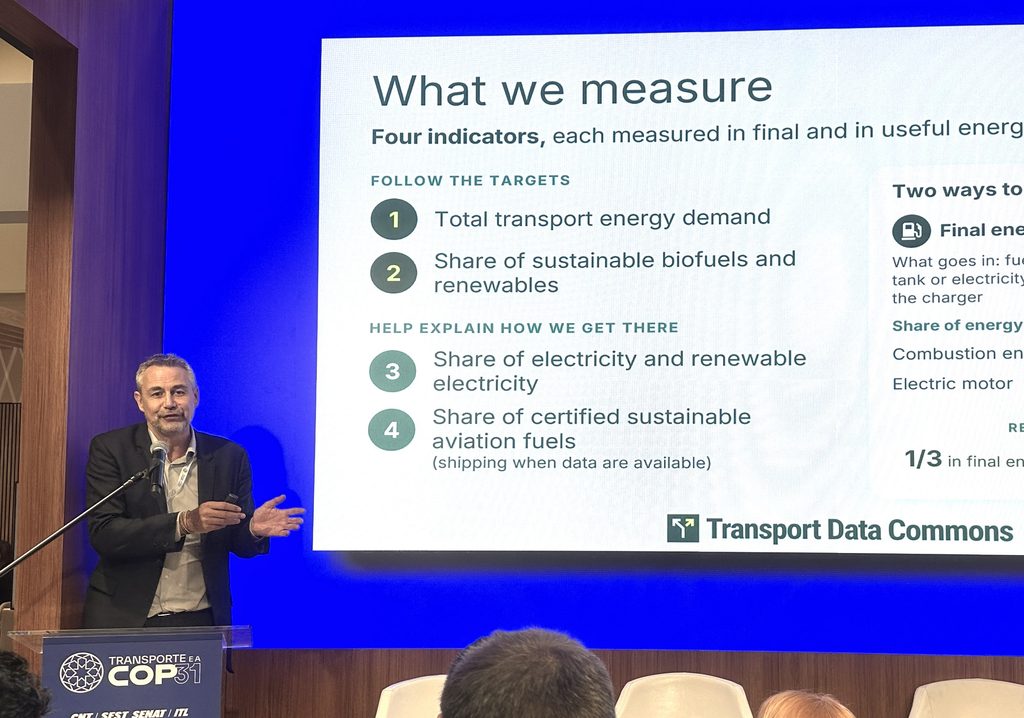
The dashboard tracks total transport energy demand, the share of sustainable biofuels and renewables, the shares of electricity and renewable electricity, and the share of certified sustainable aviation fuels.
It reports both final energy, the fuel or electricity supplied to vehicles, and useful energy, the portion that actually moves them. The distinction shows why electrification matters for energy demand. In the latest estimates presented, electricity accounted for about 2.5% of final transport energy and 7% of useful transport energy, reflecting the higher efficiency of electric motors.
The tracking results showed that global transport energy demand was still rising and renewable energy use was well below the target pathway. In the scenario presented, electrification of road and rail at 25% below the target pathway caused the energy demand goal to be missed by a wide margin and lowered the renewable share. Equivalent shortfalls in biofuels or hydrogen had a smaller effect on total energy demand, though both remain important for aviation and shipping.