

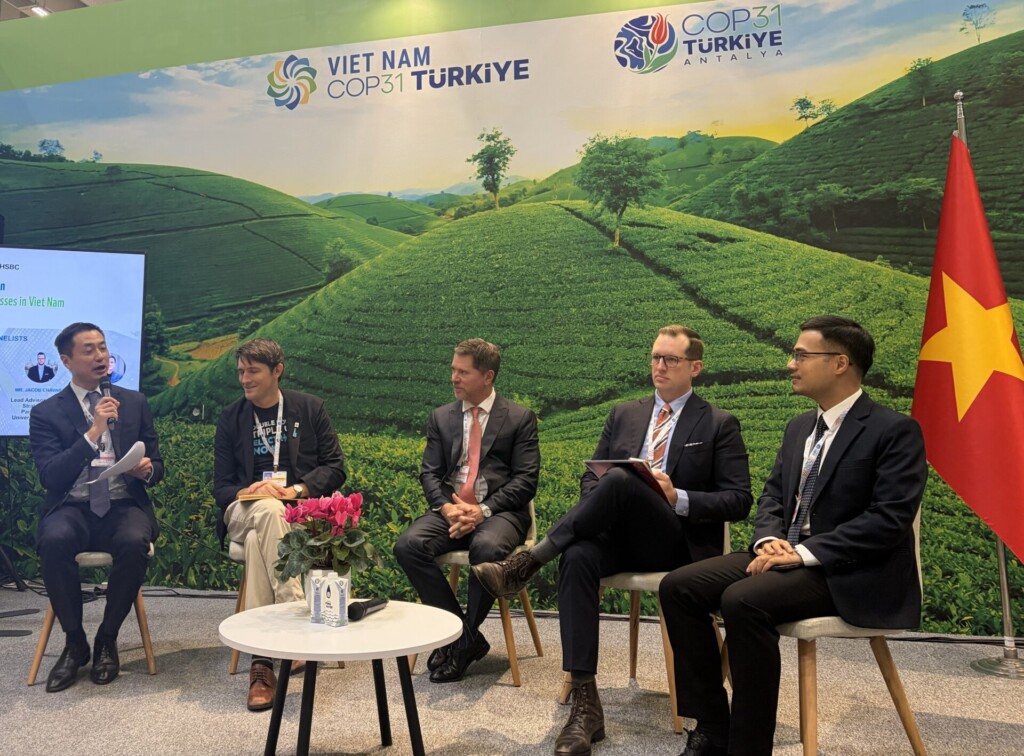
16 November, Viet Nam Pavilion, Blue Zone Host: Directorate of Climate Change (DCC) Viet Nam, WWF, HSBC
CCG’s Nguyen Hoang Nam was a Panellist and presenter
Other participants:
Bui Duc Hieu, Deputy Director-General, DCC, Ministry of Agriculture and Environment of Viet Nam, Le Thanh Tung, DCC, Ministry of Agriculture and Environment of Viet Nam, Van Ngoc Thinh, CEO of WWF Viet Nam, Justin Wu, HSBC Head of Sustainability & Climate Change APAC & MENA, Tim Evans, CEO of HSBC Viet Nam, Jacob Chavara, Impact & Engagement at Oxford Net Zero, University of Oxford.
Bui Duc Hieu opened the event with some observations:
Transition is no longer just about environmental regulation, but a key factor in business competitiveness and global supply chains. The key challenge is moving from policy commitments to action despite high upfront investment costs, limited technology access, long-term financing gaps, and capacity constraints. Focus areas for the Department of Climate Change are strengthening policy/regulatory frameworks, scaling technology innovation (low emission electricity, supply chain efficiency), and mobilising financial resources.
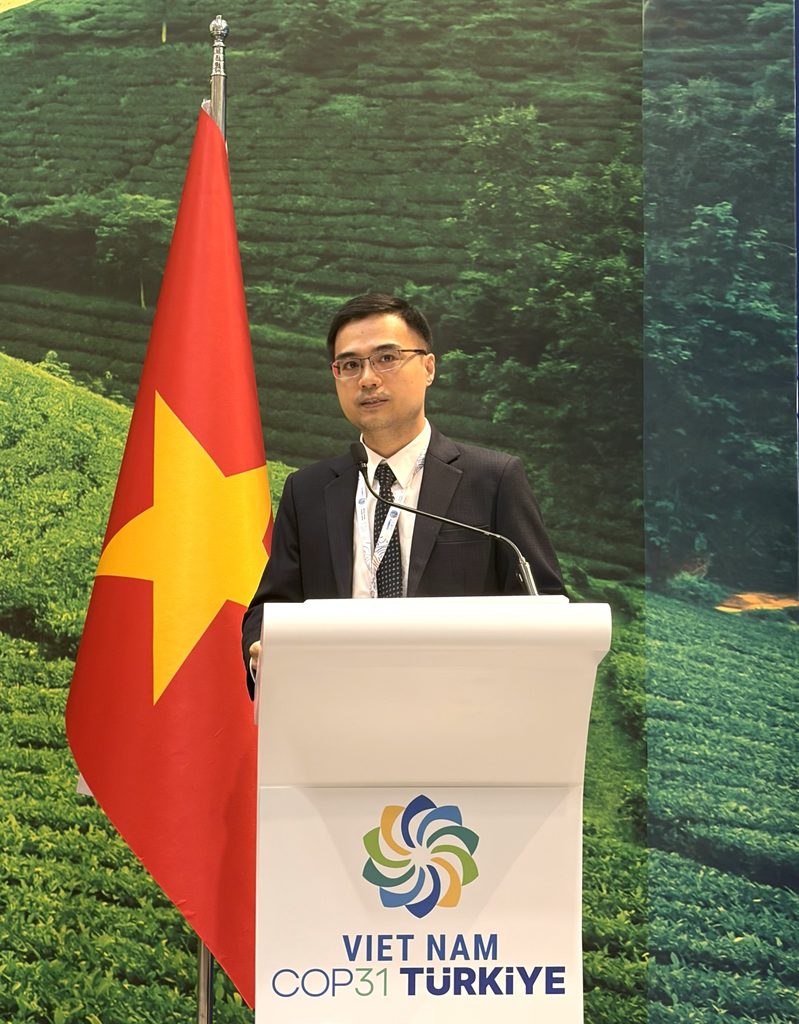
Dr Nguyen Hoang Nam (Senior Policy Advisor, CCG Country Coordinator) then presented:
He outlined Viet Nam’s transition framework across 3 levels: Decarbonising the emission system across sectors (energy, industry, cities, land/ecosystems); Systemic economic shifts (circular economy, digital transformation, institutional reform, role of finance); Improving inclusiveness, adaptation, and resilience.
He shared the timeline and progress showing a shift from commitments and planning to the implementation stage (2026). Key developments include launching the Viet Nam Carbon Market Portal, domestic carbon market pilots, Decree 29/2026, Circular 11 (national registry regulations), and Decree 112/2026 (Article 6 legal framework).
Mr Le Thanh Tung (Department of Climate Change / MAER) then talked about the following:
Domestic Carbon Market Roadmap: Foundation under Law on Environmental Protection (2020). Pilot phase 2026–2028 focusing on testing market infrastructure, compliance, and initial participation from high-emitting sectors (power generation, cement, iron and steel). Full operational phase starts from 2029 with expanded sectors and instruments.
The National Registry System serves as the central hub assigning unique identification codes to track allowances/credits (transfers, offsets, surrenders, cancellations) ensuring environmental integrity and avoiding double counting.
Article 6 Framework (Decree 112/2026): Regulates Article 6.2, 6.4, and independent standards using authorization letters, corresponding adjustments (CA), and national registry tracking. Principles: 1) Protect Vietnam’s NDC goals; 2) Follow Paris Agreement rules; 3) Equitable benefit-sharing; 4) Mandated registry reporting. Transfer limits set: Max 90% for priority list and 50% for encourage list for transfers with CA; max 90% for both without CA.
Tim Evans (CEO, HSBC Vietnam): went on to share his observations:
Financial Need: Vietnam needs ~$400 billion by 2040 (~6.8% of GDP annually) to address climate vulnerabilities. Current banking system is heavily leveraged (credit-to-GDP at ~105%). Public debt is relatively low (34–35% of GDP), allowing fiscal space for government issuance.
Leveraging Capital Markets: to diversify international capital sources. Viet Nam successfully repaid its 2014 $1B international bond in 2024 (now has zero outstanding international public debt). Credit rating upgraded to BBB-. Sovereign green bond issuance is under consideration, making it one of the first Asian issuers outside Indonesia/Malaysia.
Corporate Financing Deals: SACE (Italian ECA) backed $140M green financing for Gelex Group and Thaco Agriculture. Masan Group raised $750M syndicated loan across 15 lenders. Nafoods raised $31M in VND-linked sustainable financing. VinFast tapped international markets (including 2021 exchangeable bond).Requirements for Corporates to Access Capital: include Independent credit risk ratings, enhanced financial and ESG disclosures, verifiable reporting to avoid greenwashing risks, robust corporate governance standards, and accelerated digital/AI adoption.
Van Ngoc Thinh (CEO, WWF Vietnam): said that their key approaches include Landscape-scale Nature-based Solutions (NbS), sectoral transformation, and locally led conservation. Engaging the private sector across supply chain decarbonisation and natural carbon sink enhancement (eg mangrove restoration, FSC forest certification management). He also covered partnership and AI: Partnerships with major corporates (HSBC, H&M, IKEA). He highlighted capacity challenge for SMEs that lack dedicated in-house sustainability teams; emphasized leveraging AI tools to streamline carbon accounting, feasibility studies, and financial calculations at lower cost.
Panel Discussion:
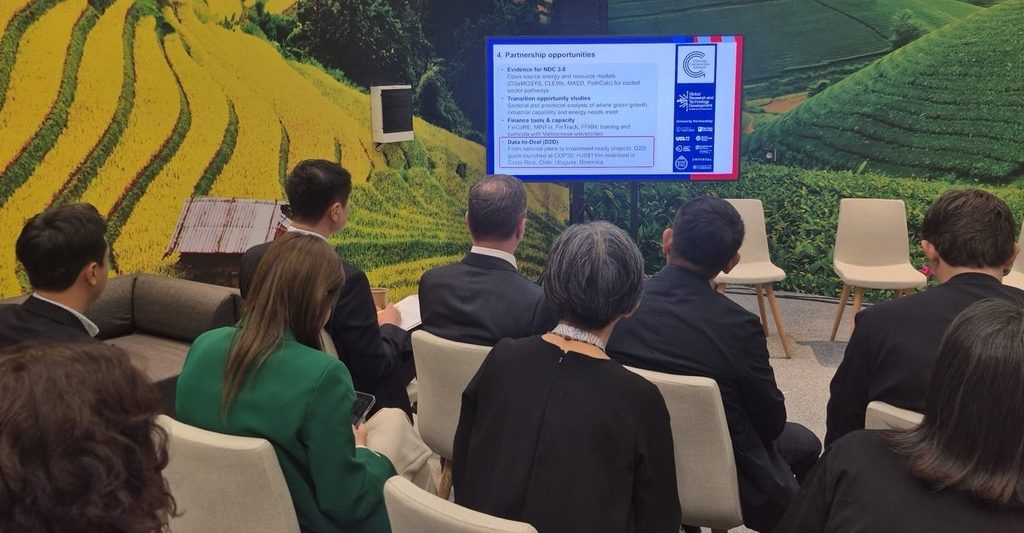
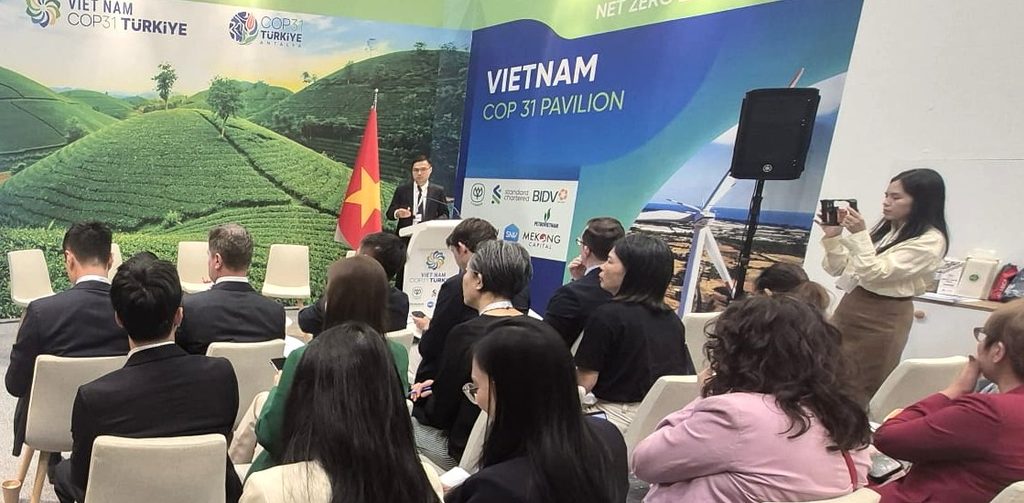
Nam highlighted Viet Nam’s need for Policy Predictability: Critical factor for businesses and financiers to commit long-term capital. While national level target setting (Net Zero 2050) ranks high globally on ambition, detailed implementation policies need consistent, predictable execution frameworks.
The other panellists discussed International Standards Alignment: Adopting international frameworks (SBTi Corporate Net-Zero Standard, ISO Net Zero standards) helps Vietnamese corporates benchmark performance and attract ESG-aligned capital.
Nam mentioned these needed skills for businesses to accelerate energy transition: 1) Measurement (baseline inventory & impact measurement); 2) Strategic planning; 3) Transition finance & bankability structuring (eg thermal/coal to electric/biomass boiler conversions requiring high upfront capital despite clear long-term savings). CCG is working with the government to provide training, especially on finance. If we can measure, we can better mobilise finance.
Final Actionable Takeaways:
Don’t wait for final regulations: Businesses should immediately begin emissions measuring, baseline data collection, and verification, as data collection takes time and verified data is required by financiers.
Nam: Financiers must be aware of the changes happening now. There is a big need for support dedicated to feasibility studies (such as industrial heat pump and electrification projects) to build bankable project pipelines.