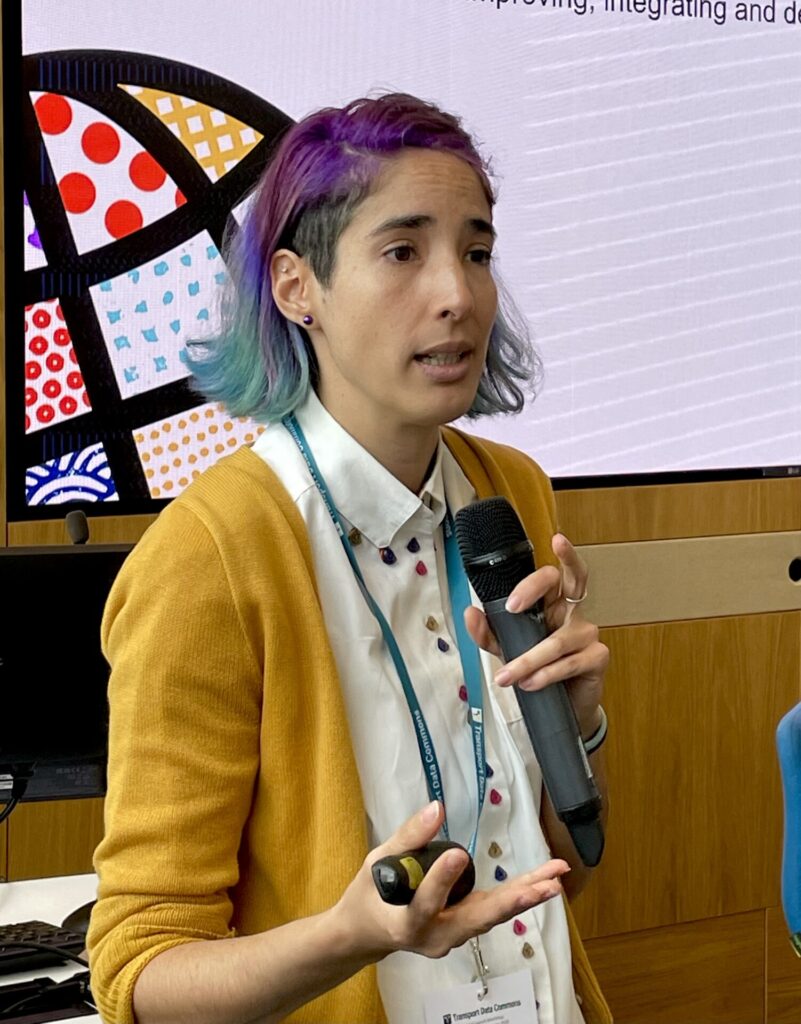
Andrea is the Founder of an NGO called the Center for Urban Sustainability in Costa Rica, and Co-Founder of an international consulting firm called Agile City Partners, where the Global Partnership for Informal Transportation was born. Now the Global Network for Popular Transportation, Andrea serves as its Executive Director). Andrea is also a visiting lecturer at UPEACE and a freelance consultant and advisor for different projects and initiatives related to sustainability, inclusion, cities and transport. Here Andrea speaks to CCG’s Peter Allen.
How useful has this event been for you?
It’s been really useful to understand the structure of the Commons, the team behind it, and the processes around uploading data and using it. Understanding the community of people who are going to be connected by TDCI is great too, knowing who is behind that information and being able to ask them questions. So, it’s been valuable on many different levels.
What’s the optimum position you think TDCI could get to in terms of data sharing?
In terms of my sector, which is one that is usually invisible in transport conversations and transport policy, I’d love to reach a point where we can see the information we need, on this open-source platform, and that people can start generating new insights and from there, new policy and strategies. Right now, it’s very difficult even to justify the need for action in the sector when you don’t have the numbers. How can you convince someone that we need to decarbonise when you can’t say how many tons you could potentially reduce or how many vehicles you need to decarbonise, right?
What is the importance of GESI in the Sustainable Transport sector, and collecting and sharing data on that?
I think it’s important because it will give you insights not only on technology and numbers and infrastructure, but on the people who use the transport services and their patterns and needs. At the end of the day, if you want people to keep using public transport services, we need to figure out why they use them, what they need from them and how to improve their experience.
Women caregivers are the biggest users of public transport services so it’s important to understand their travel patterns, and which routes they need, to inform planning. So, it’s about understanding the motivation behind designing services. If the data is only about what’s there already, and the infrastructure and the vehicles, we’re missing the point of why we’re collecting data: what are we doing it for and WHO are we doing it for?
That’s likely to be qualitative data research, isn’t it?
It could be about taking the quantitative data and separating things between users to see if the actual designs are serving those users. It’s another level of analysis, which will make you get better insights and understanding on whether your services are actually serving the public that uses them.
What is your view generally about the progress that’s being made towards, very broadly, the decarbonisation of transport? Are you optimistic about how it’s going to go?
I’m always an optimist. However, I think that there is disproportionate attention being put on electrification and a disproportionate amount of effort going to mass transit, which takes a long time, while other modes might be neglected a bit. For me it’s not an either-or conversation, we need to do both. We need to do long-term planning with mass transit, of course, but we also need to figure out how to improve the services on the ground that people are currently using, which is their day-to-day experience. For example, a lot of people walk to work every day. A high-speed railway might be nice, but if you don’t even have a sidewalk to get to that rail service, then demand will not be there once you put it there, and the projects will fail. We’re seeing this happen in so many places. Mass transit projects that are failing because there was no thought put into the surrounding ecosystem.
If you can’t walk to them, and if you can’t take the motorcycle taxi because it’s illegal, if the bus is unsafe, if you can’t get transport at night, then it all kind of fails. We need to think about the network and the different components of the system beyond just the big infrastructure projects that are the ones that are more attractive to fund. We also need to try to figure out how to create business models and funding for the smaller operators – the entrepreneurs – that are usually ignored, or that governments try to replace with these big projects. The evidence says that it doesn’t happen. Culturally, they’re very well established, and they are very useful in terms of bringing connectivity to the rest of the city. A mass transit project has usually one large corridor or a couple of corridors, so the smaller roads are not served by those large projects as we saw in one of the presentations today. Those small roads – and the people who live there – are served by other smaller vehicles and transport providers, so we need to NOT leave them behind in this process of decarbonisation; we need to work on a diversity of modes and create a diversity of options to finance, to find business models, electrify, shift to newer vehicles and so on.