
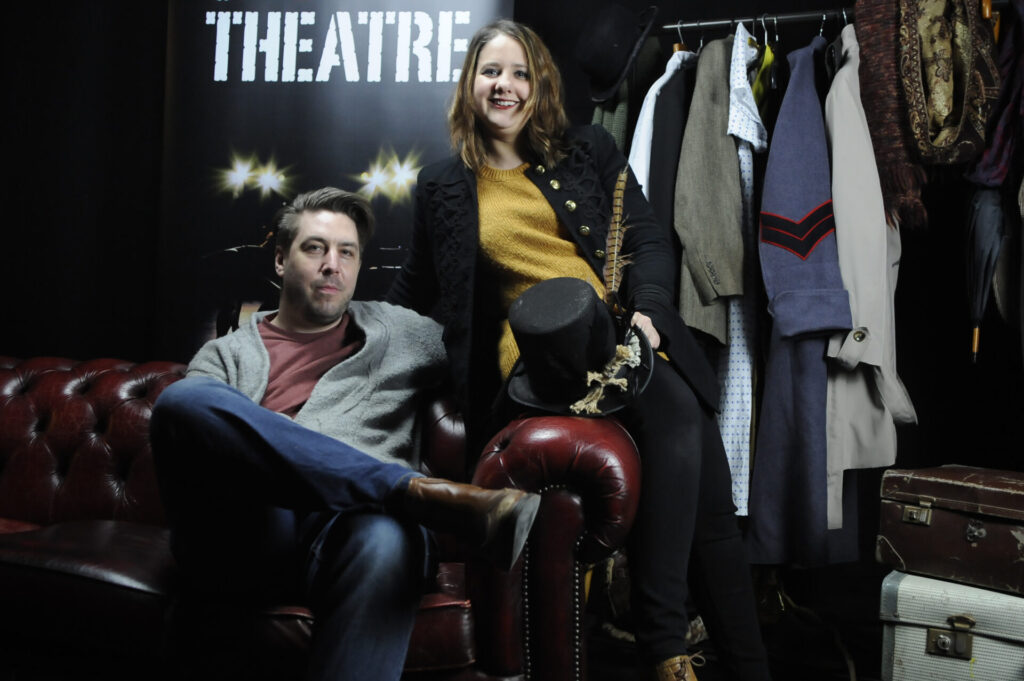
Hannah Marquez founded Rebellion Presence with her husband, Luke. Using lessons from her background in Acting and Corporate Communications, Hannah works closely with technical thinkers, scientists, engineers, and lawyers, to enable them to present and talk about their knowledge in a more impactful way.
Clients include Arm, GE, Ravago, Lincoln’s Inn and others. Here she discusses the challenges faced by women in the scientific sector and the importance of creating relatable stories from the data produced by climate researchers.

Tell me about your life and career before you founded Rebellion Presence.
I trained as an actor, studying performing arts at university. When I left university, I found myself in a very competitive industry. I got into marketing by accident; I took a six-month temp job and found I loved it. I went on to become a chartered marketer and did very well in the corporate environment, working for brands such as Dyson, Vodafone, and others.
What I found was that the way I progressed in the corporate world was by using the skills I’d learned as a trained actor. Communication skills are incredibly important when you’re trying to persuade stakeholders, and actors and theatre-makers are natural storytellers. Working with some of the best engineers in the UK at a company like Dyson, and with James himself, I found that interpreting complex engineering data and turning it into stories people could relate to was something I was naturally good at, because of the training and experience I had. It’s been an incredibly interesting career.
Why did you start Rebellion Presence and what does it do?
Originally, we started teaching adults acting many years ago. What we found was that people would also come to our classes not to be actors, but to learn confidence and to improve their voice. People started to come back and say, “I’ve just done an interview, and if it wasn’t for these acting classes, I don’t think I would have got the job.” So, we decided to combine my experience in corporate with Luke’s work in developing actor training methods.
When COVID hit and everything was put on hold, we had the headspace to develop what we have today. We created a system called the Anima Method that technical minds can apply, and people often describe it as life-changing for them because suddenly they’ve got the confidence to hold a room. Very quickly, we started to work with global organisations like Boston Consulting and GE Global. What we did worked, and we’ve now created a really successful organisation working with lawyers and technical thinkers.
Why that name, Rebellion Presence?
We’ve always been a little rebellious! We like to do things a bit differently. The Actor Rebellion is our acting school, and we’ve taken the name from that. And presence is about being present, and having presence in the room.
Are there issues that perhaps women face more than men?
Absolutely. The challenges that women face are universal, certainly in scientific industries and engineering, which are male dominated.
And the climate sector as well, unfortunately.
The issue with that is, because of the years it’s operated as a male-dominated industry, it sets the tone and the expectations of how to operate. For example, we start to accept a deeper voice as being one of authority. That comes up time and time again. I’ve had young female lawyers who have been told that they need to sound more like a man. And that’s absolutely the wrong advice, because that is not an authentic voice for them. A woman’s natural register is not the same as a man’s. Now that women are taking up more space in these industries, we’re finding ourselves in an environment that hasn’t been set by us, and that’s where there’s a disconnect.
But really, I think the biggest challenge, and certainly one I’ve experienced myself and still do, is that we have more self-doubt, which sometimes gets labelled as imposter syndrome. There is definitely a gap in the way we think about our ability and what our abilities actually are, our knowledge versus how we’d rate that knowledge. And that holds us back. It may be that we don’t interview for a job we think we’re not good enough for. We don’t volunteer to present the data to the board because we simply don’t think we’re good enough. I see that time and time again, and a lot of the work I do is building on that confidence and giving women the tools to feel more self-belief. We work on voice, physicality, intention and breath, so it becomes second nature, and our female clients know that when they go into the room, they don’t need to worry about any of that and they know how to control their nerves.
And the women I speak to certainly know what they are talking about because they have done the work on mastering their subject.
In my experience, when women enter that workplace, we’re faced with more scrutiny over our work, and women feel like they need to prove themselves more. So generally, the preparation and work are solid. With the combination of all that prep work and then giving women a confident voice, it can be career-changing.
Yes, one releases the other.
The other thing I’ve come across is how colleagues don’t seem to think that communications is something they need to think about, and marketing is a dirty word.
“Paint pretty pictures” is what we used to hear quite a lot! I’ve worked within marketing for pharma and tech and was tasked with creating comms to promote highly complex products or ideas. The perception of marketing was always a challenge for marketers working with scientists and engineers. In fact, at Dyson, we weren’t even called the marketing department.
Marketing was almost a dirty word then, but effectively what we were doing was storytelling. We were taking the data and telling people why they should care about it, humanising it. That’s really important when presenting data, especially if you’re not presenting to other experts.
People think storytelling is a novelty or a gimmick, but what storytelling should do is elevate the truth and tell people why they should care. It should bring the data alive, because that is how you persuade somebody. You have the credibility of the data, but you also need the empathy, the pathos. Then you can harness the power of persuasion and storytelling.
How do you see communication skills in the light of the rise of AI?
Those human qualities of empathy and storytelling are vital, especially now, when we live in an AI world. Suddenly, there’s no scarcity of research, papers, and knowledge. Before AI, producing the analysis was the bottleneck. Now AI has all but removed it, and a new bottleneck has taken its place: getting people to understand, trust and act on what you’ve found.
A lot of communication in the climate sector seems to rely on graphs showing stats in the belief that that will be enough to make the point.
Effective communication is also about memory and recall of what’s been said. As soon as the audience walks out of the room, remembering those statistics is a lot more difficult than remembering a story created from them. If you want to create a longer-term impact, those stories are what’s going to stick.
Yes, the data gives the story credibility because it’s not just a fiction, but the story is the thing that connects with your audience.
Absolutely. And human skills are going to put organisations and people ahead. In a world where we have so much knowledge, so much information, the challenge will be about who’s able to make people care. So, credibility also needs to be in the person telling the story. If you’re standing up in front of a room of people, how you communicate with your voice and your body language is crucial. Are you looking nervous? Are you looking confident? You may be feeling nervous, but how do you portray a different story? How do you portray credibility yourself? That’s going to become more and more important.
Our background is in acting for screen, which is rooted in truth. If people think you’re pretending, your message will be lost. We work with people to show up as their authentic selves. A lot of us do struggle with that, especially if there’s self-doubt involved. But if you’re just reading the data, you end up with a monotonous delivery, and nobody is paying attention, there’s no musicality in the voice.
So, we teach you how to make your presentations interesting, and also how to maintain that authenticity. We’re all natural storytellers, and it’s that natural storytelling skill that we want to take into the workplace.
What do people typically not do right when you first come to work with them?
The thing that powers everything, our nerves, our voice, is breath. People forget to breathe! When we become nervous, our breath becomes shallow and fast-paced. And then what happens is it affects our nervous system. It speaks to our brain and tells us that we’re in danger. And then we end up in this cycle: we speak really quickly, we lose our breath, we start to shake, the nerves set in, we start to shift our bodies. If I were to give one piece of advice, it would be, breathe. Notice your breath, and take a breath after each thought.
People might think that acting and corporate communications are mutually exclusive worlds – one is very free and the other more restricted. What’s your view?
If you train as an actor, you realise that actually what comes with that is a lot of discipline and teamwork. You’re always working with teams, often to incredibly tight deadlines. And you’re working with stories and human emotions too. A big part of acting isn’t delivering lines, it’s actually being responsive to what you’re hearing and letting it affect you. All of those things translate really well into the corporate world.
Is there anybody you would point to who you think is getting it right?
The mathematician Hannah Fry is a great female presenter who comes to mind. She shows up as her authentic self and brilliantly translates complex data into stories that people can relate to.
And a final thought to leave us with?
I think people underestimate the importance of good communication skills, particularly when they’re brilliant in another area. But brilliant minds can be easily overlooked if they’re not great communicators.
Based in the UK, Rebellion Presence delivers 1-2-1s and group workshops in Public Speaking, Personal Impact and Storytelling, both online and in-person.
Find out more at www.rebellionpresence.com