
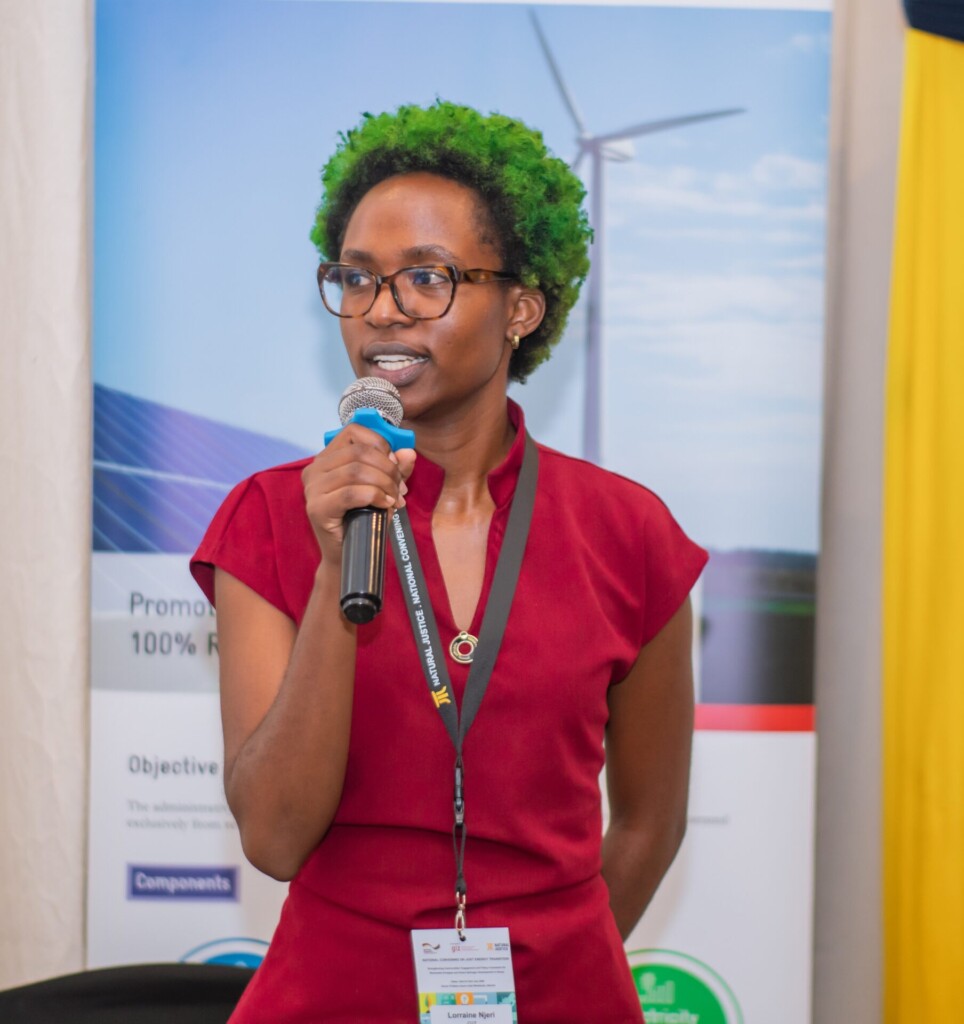
Lorraine is a Climate and Energy Junior Technical Advisor, working with Deutsche Gesellschaft für Internationale Zusammenarbeit (GIZ) GmbH, and the Ministry of Energy and Petroleum in Kenya. She specialises in developing an Enabling Policy Environment for Emerging Energy Technologies across Africa—with a focus on supporting Kenya’s transition to a green hydrogen economy. With a background in Agricultural and Biosystems Engineering, Lorraine applies a systems-thinking approach to the Water-Energy-Food (WEF) Nexus, championing sustainability and its opportunities for: clean energy for all, economic growth and climate action all in one. She works closely with national policymakers and subnational governments to bridge the gap between high-level regulatory frameworks and inclusive, on-the-ground urban development.
Lorraine’s impact spans intergovernmental policy advice, sector coordination, and institutional capacity-building. By guiding inter-ministerial Technical Working Groups and driving multi-sectoral Urban Living Labs, she ensures that emerging climate solutions are both sustainable, scalable and socially equitable. Her core areas of expertise include Green Hydrogen Technology, Nature-Based Solutions (NbS), Disaster Risk Reduction (DRR), Flood Management, and ensuring a Just Energy Transition for Renewable Energy affected communities.
Tell us about your role at GIZ
I serve as a Junior Technical Advisor on the “Developing the Foundations for a Green Hydrogen Economy in Kenya (GH2F) Project at GIZ Kenya, implemented on behalf of the German Federal Ministry for Economic Cooperation and Development (BMZ) in partnership with Kenya’s Ministry of Energy and Petroleum.
The project supports Kenya in laying the foundations for a green hydrogen economy — advising decision-makers on the legislation and regulations needed to make green hydrogen production a reality, while building local expertise and expanding public knowledge of the technology’s potential.
My role supports these efforts through three areas: policy development support, working with government institutions on regulatory frameworks for the sector; institutional capacity building, strengthening the skills and technical expertise Kenya needs to run a hydrogen economy; and just energy transition, ensuring that communities, youth, and workers are part of shaping how the sector grows.
Overall, my work sits at the intersection of policy and energy. I focus on co-organizing inter-ministerial dialogues that build government buy-in for this emerging technology — supporting Kenya’s ambition of a 100% renewable energy-powered future and the broader development goals of Kenya Vision 2030.
What are the day-to-day activities you’re involved with?
My day-to-day is highly dynamic, but it generally falls into three main areas. First, a big part of my day goes towards stakeholder engagement and ensuring a just transition. Green hydrogen is a complex and unfamiliar technology for most people, so I spend significant time supporting and facilitating dialogues across government, the private sector, academia, and local communities. We explore benefit-sharing concepts and new areas of collaboration, because a just energy transition only works if everyone is part of the conversation.
On the policy side, I support the development of sector-specific policy briefs and implementation plans (energy and agriculture sectors). This involves identifying organizing regulatory roundtables to understand overlapping mandates and streamlining existing policies so that green hydrogen production — alongside derivatives like ammonia-based fertilizer — can be safely integrated into national frameworks. Most importantly, ensuring that our efforts align with Kenya’s Green Hydrogen Strategy and Roadmap (2023).

Beyond that, a lot of my time goes into convening, capacity building, and knowledge management. I organize dialogues, workshops, and peer-to-peer exchanges that bring Kenyan institutions together with international partners such as Europe, Indonesia, Sub-Saharan Africa. A major focus right now is strengthening industry-academia linkages and exchanges on how best to support Research, Innovation and Development of GH2 in Kenya.
It seems that Kenya is a dynamic place when it comes to renewable energy and tackling climate change. Is that your experience?
Yes, for sure. Around 90% of Kenya’s electricity generation already comes from renewable sources — geothermal, hydro, wind, and solar — which places us among the world leaders, not just Africa’s. . Kenya leads the African continent in installed geothermal capacity and ranks sixth globally. That foundation is exactly what makes green hydrogen possible here: you can only produce truly green hydrogen from green electricity, and Kenya has this potential.
Is Kenya planning to export electricity to other countries?
I can’t really speak on this, as there are a lot of technicalities affecting that decision. What I can speak on is my exposure to Kenya’s effort in terms of energy/electricity access. The government is committed to increasing access to electricity from current 75% to 100% by 2030 by connecting an additional 5.1 million households.
What are the challenges with introducing hydrogen?
There are quite a number, but I shall focus on what I believe are the critical ones.
The first challenge — and perhaps the least obvious — is demand and offtake. Kenya has always been a consumer of hydrogen and its derivatives without producing them: we import nearly all our fertilizer, hydrogen is embedded in industrial processes like cement and steel, and it features in refined hydrocarbon fuels. So, while the demand exists, it has always been met through imports. Building a domestic production industry means converting that import demand into local offtake — securing buyers willing to commit to locally produced green hydrogen products — and without those offtake agreements, projects struggle to reach implementation, no matter how good the technology is.
The second is production cost. Green hydrogen remains more expensive than conventional alternatives, and the electrolyser technology is still costly and largely imported, dependent on critical materials, so upfront capital costs are high.
Third is the skills gap. This is a new industry for Kenya and most of the continent, so the technical expertise — from engineers and technicians to safety inspectors and regulators — is still being built. Technology transfer only works when there are skilled local hands to receive it, which is why strengthening our TVET institutions and universities is a core pillar of our project.
Fourth, policy and regulatory gaps. Investors and developers need clarity on permits, licensing, safety standards, certification, and sustainability criteria before they commit capital. Much of this framework is still being developed and that’s the work our project supports, advising government institutions as they build it.
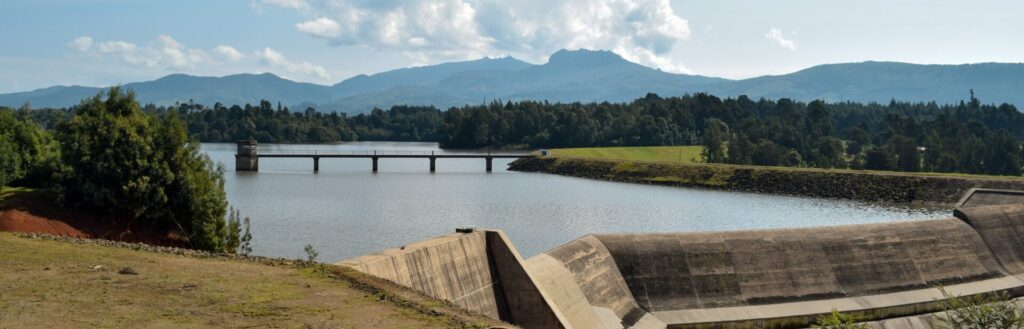
Finally, sustainability. Producing one kilogram of green hydrogen requires a minimum of about nine litres of water, so project siting must take water access and competing community needs seriously. Equally important is social acceptance: roughly 70% of Kenya’s land is community land, so communities asking, “how does this benefit us?” is not a side conversation — without genuine benefit-sharing and trust, projects cannot even secure land to begin. Still, we’ve seen this before — both wind and solar, Electric Vehicles (EV) faced similar hurdles in their early years and are now the backbone of our grid.
Where is the money coming from for these projects?
Right now, it is from international and bilateral development partners, multilateral and programme-based instruments such as UNIDO/ A2D Facility and GET; Investment and blended finance particularly through Public-Private Partnerships (PPPs). We’ve seen support from the German government, European Union (EU) – Global Gateway and interest from the Chinese government. So now there is a lot of encouragement for PPPs in terms of purchase agreements to support these.
My understanding is that when you’re bringing in external private suppliers or private investors, there’s an issue about policy alignment. How is that in Kenya?
I recently learnt that the phrase for this is, I believe, inter-policy conflict. Whenever you are working to support the integration of a new technology through policy, a common headache is ensuring that that sector-specific policy document is building on the existing national and subnational policies and not overlapping mandates or complicating the existing process of regulation, licensing , approvals and permitting. It’s a very real issue — and a large part of my day-to-day work. Investors need predictability: clear rules on permits, licensing, safety, and incentives before they commit capital. Kenya is actively building that framework, and part of my work is ensuring we align with what’s working in the larger region, so we’re learning from our neighbours rather than designing in isolation.
What I have gathered so far, is that the deeper alignment question is economic. When we discuss financial support — incentives, tariffs, fiscal terms — we’re really asking: how do we design a framework attractive enough for a developer to invest, but not at the cost of the community? Investors want returns; communities want benefits; the country wants industrialization. My work sits in the middle of that triangle. The question we keep returning to is: how do we design binding policy that genuinely delivers on the words “just and equitable” — not as a preamble sentiment, but as enforceable provisions?
Tell me a little bit more about that. It’s a little unusual to take such steps to include the community.
What we’ve seen from a couple of previous renewable energy projects (solar and wind), is where the community have rejected that particular investment. The pattern is usually one of three things: the community wasn’t informed before development began; the information shared was misconstrued along the way; or they saw no economic opportunity for themselves beyond casual labour during the construction phase. And underneath all of it is the question of livelihoods — particularly where land is needed for a green hydrogen plant and people face displacement from the very ground they depend on.
That’s why the just energy transition (JET) is one of the core pillars of our project, the “Green Hydrogen Foundations Project”. The vision is to engage government, private developers, and communities together so that as we build this green hydrogen economy, we don’t replicate the societal injustices of previous large-scale energy projects.
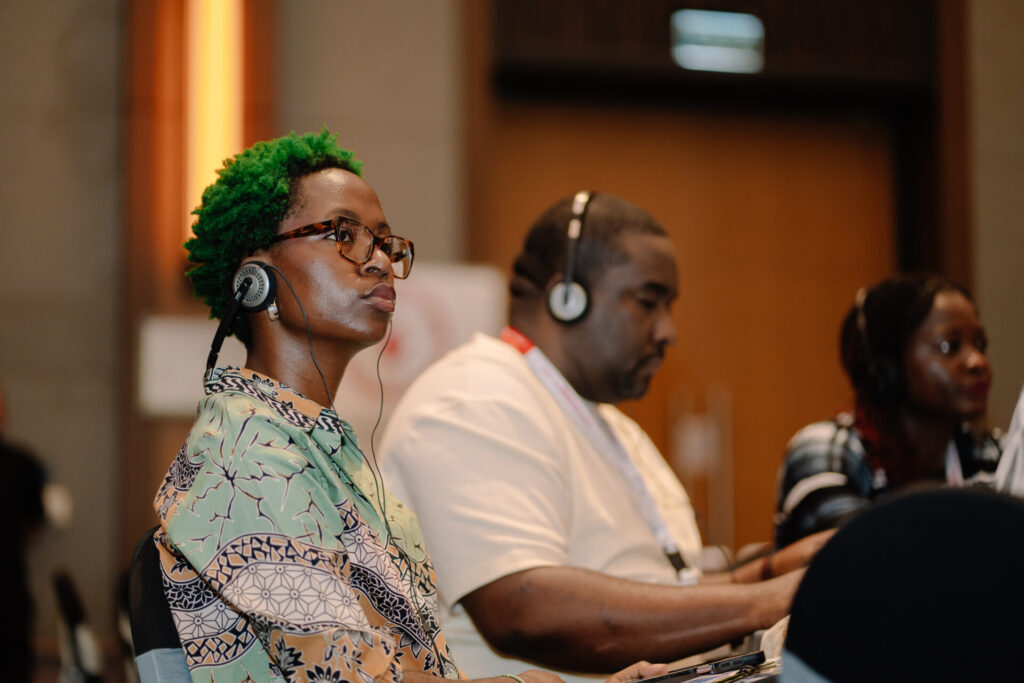
Actually, this May, the Ministry of Energy and Petroleum and GIZ convened the 4th Annual Green Hydrogen Symposium with a dedicated just energy transition component. We brought community representatives from five counties already affected by renewable energy projects — Garissa, Marsabit, Narok, Nakuru, and Kajiado — into the room. They shared their grievances with existing projects, discussed what an equitable benefit-sharing mechanism with a project proponent should actually look like, and engaged with what hydrogen is — both its promise and their reservations. It’s never easy work. But I think that’s the beauty of anything that deals seriously with environmental, social, and governance questions
I feel particularly honoured to work on a project that centres community voices — including through approaches like living labs, which are built on the recognition that communities hold knowledge that should guide development, not just receive it. Policy is made at the national level, but wisdom about place lives locally. Or better yet as Prof Ian Scoones says “ The community members are crucial high-reliability professionals in designing a future that is uncertain and one that requires us all to adapt to the unfolding uncertainties in real time.
Thank you. GIZ has an ethos that is similar to our own. Tell me a little bit more about nature-based solutions which is another part of your role.
So this actually goes back to before the energy conversation entirely. It was one of my core tasks, before transitioning into green hydrogen. I studied agricultural and biosystems engineering, specializing in the environment and water engineering — and my curiosity started with an alarming lecture about a doubling population, shrinking agricultural land and the looming food insecurity crisis. That sent me down a rabbit hole: on the role of water availability, issues on ground sanitation, freshwater scarcity, and eventually how deeply all of this is tied to climate change.
That background is what brought me into the Covenant of Mayors in Sub-Saharan Africa programme early in my career (one of my most fundamental experience) where I was working with two sub-national governments dealing with severe urban flooding have often led to property damage and disrupted livelihoods. And that’s really where nature-based solutions came in — using my environmental engineering training to help design green infrastructure that works with natural processes instead of against them.
Two examples I love. In Mombasa, a coastal city with serious flooding, we supported the county’s flood management strategy — including rethinking something as ordinary as pedestrian walkways. Instead of solid concrete slabs, you design them to be permeable, with pockets of plants and sand, so floodwater infiltrates the ground rather than pooling on top of it.
Then in Embu, the terrain is very hilly, and many lower-income residents live in the valley below the town — so every heavy rain sends stormwater rushing downhill into their settlement, destroying homes and sometimes costing lives. In the Dallas informal settlement there, the county government and residents co-developed a Dallas Informal Technology Green Infrastructure Plan. (Green Infrastructure in Action: Pilot Project Launch in Dallas, Embu) which I believe has won an award and its first pilot has now been built: a flood-prone junction transformed with a permeable surface, and proper drainage — plus a shaded public space, a children’s playground, and a laundry zone. The priorities came from the residents themselves. Water that used to flood homes now soaks into the ground, and a hazard became a community asset.
The funny thing is, I went into nature-based work to fight the water and climate crises for the sake of agricultural security— and it was doing that work that showed me the biggest influence to the conversation on agricultural production, is not just water scarcity, nor is it just climate adaptation but rather the role of energy sector in the grand scheme of sustainable development and food security . That realization is what pulled me into green hydrogen. In a way, I’ve traced the climate-land-energy-water nexus in reverse: I started in water and climate (adaptation /mitigation) and followed the problem upstream to energy.
Where did this interest come from originally?
I’ve always had an interest in agriculture and food security. When I began my university studies, I learned that in ten years the population would have doubled, while agricultural land would have reduced, making food production a challenge. Because of the issues of sustainability, food security and water availability, I went into a rabbit hole of water and sanitation and understanding the scarcity of fresh water and the implications for the people.
Then I learned that the availability and quality of water is dependent on climate change and I came to understand the connection between them. I also learned about greenhouse gas emissions and explored what I could do as a scientist with my certification in agriculture, soil and environment. I joined the nature-based emission side working to design this clean infrastructure but then I learned that the biggest emitter was the energy side. That’s when I started planning a transition from the water environment into energy to really understand what this issue is that we’re trying to solve on the other side of the world. I’d say it’s a lot of curiosity in trying to find the root cause.

Would you say that your early interest in agriculture and food security was unusual for a woman?
Honestly, it was unusual to many. Firstly, Agriculture was not an admired course — when we were doing course selection in secondary school, I can barely remember anyone intentionally putting an agricultural course as their first choice. And the discipline I chose, Agricultural and Biosystems Engineering, was so new in Kenya that even accreditation required the Engineers Board to validate the programme with our institution. Funnily enough, I had actually applied for an AgriBusiness undergraduate course and somehow landed in an engineering discipline instead — and it turned out to be the best accident of my life. Then within that, as a woman in STEM, the imbalance was right there in the lecture hall: roughly two-thirds men to one-third women.
But the interest itself came from my teenage years in Mombasa, where I grew up watching my mother — a teacher by profession — somehow run a whole farm on the side, while we lived in town. One productive dairy cow in our backyard, with milk deliveries on schedule. 1500 Layer chickens, with eggs distributed across our estate and to shops beyond. At different points she experimented with ducks, even rabbit farming. So subconsciously, I had already witnessed that agriculture could work as a business — that I could employ myself and earn independently, without waiting for a job to be given to me. I had seen the monetary value of crop and animal production with my own eyes.
So in hindsight, having witnessed my mother do this out of passion, it was definitely not unusual for me.
Are there any positive or negative experiences that you have had in your career because of your gender?
For the positives in terms of my career, I’m very fortunate to be in an institution that really upholds gender equality and policies around it and protection around it. When it comes to my career, I feel that during my time at GIZ, I have felt protected as a woman.
I do have some cons before joining GIZ. During my third year on campus, I unfortunately experienced sexual harassment from a male lecturer. It was quite a tough time, and scary, because of the explicit threats that this lecturer made to me if I continued to reject his innuendos. But what really helped me was reaching out to a fellow woman lecturer within the institution, who was my Second year lecturer on the units” Fluid Mechanics” and “ Wastewater Treatment Technologies”. She helped me a lot and she also spoke to me about a similar incident that she experienced during her undergrad course.
It’s something that makes undergrad women students feel helpless because you’re young and unsure of how to proceed. But the advice that I always give is to try and look for a woman representative within the institution that you trust or feel safe around, confide in them and you’ll be pleasantly surprised at how much support they’ll be able to give you to the very end.
Because of that experience, when female interns come to me, I always make it a personal priority to reach out and encourage them to seek out someone that they feel safe with and confirm to them that I would be available if they do want to reach out. But in terms of GIZ, I would go as far as to rave about it being an institution for women to thrive in.
Now that I look back, I know this particular experience with my Confidant and her expertise, also shaped my interest in the Water Resource Management side of my early-career.
I’m so sorry that happened to you. I hope that how you resolved it will inspire other people who read this to realise that there is somebody they can talk to.
How do you feel your perspective as a woman is of benefit when looking at a very complex subject like climate change and how to deal with it while also balancing the growth ambitions of a country?
I’m not sure if I can describe it as a gender advantage, but there’s an advantage that I’ve curated for myself as a technical figure in this “complex subject”. I am an aspiring expert within the climate change field, who believes that the change shall be achieved through a multi-sectoral collaboration and exchange of our various efforts in the fight against climate change and energy security. I am utterly passionate about re-designing exchange platforms, where I get to question, learn and brainstorm technical concepts with renowned experts.
There is a difference from dealing with traditional expertise that I’ve noticed, possibly because the topic is novel, but a lot of these conversations come from workshops or conferences, so my main question is how do I make these conversations accessible to the greater public, and most importantly the younger generations, or to the interested experts in different fields? And my contribution to this “complex subject” is by publicizing and co-organizing webinars, through the likes of the Africa Youth in Green Hydrogen initiative.
Thank you so much, Lorraine.