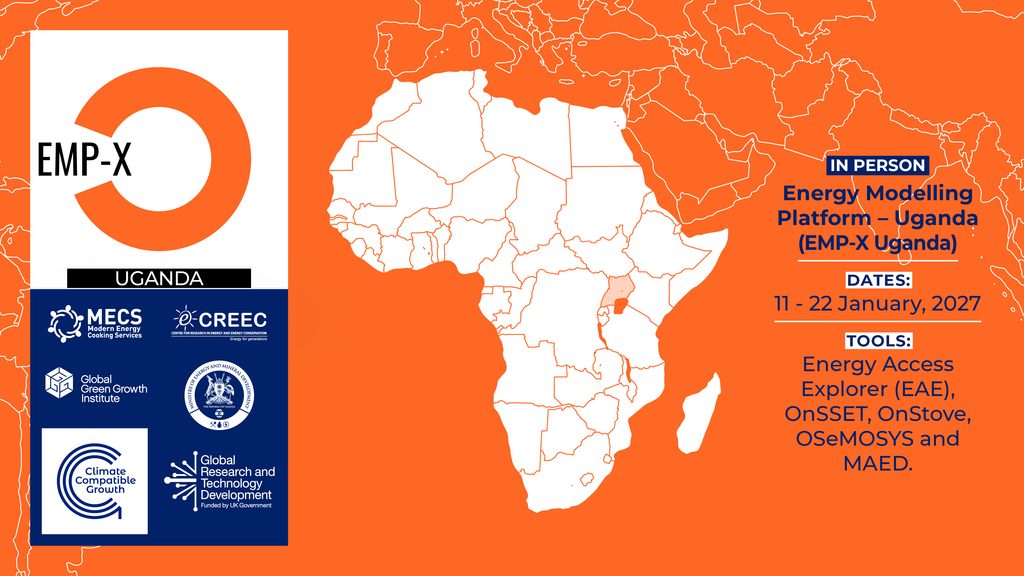
The Energy Modelling Platform – Uganda (EMP-Uganda) is a country specific EMP held by the Centre for Research in Energy and Energy Conservation (CREEC) and the Ministry of Energy and Mineral Development (MEMD), with support from Climate Compatible Growth (CCG), Modern Energy Cooking Services (MECS) and the Global Green Growth Institute (GGGI). This will be the first EMP-Uganda.
EMP-Uganda aims to strengthen the technical and institutional capacity of selected participants in Uganda to apply energy modelling and geospatial decision-support tools for evidence-based energy planning, scenario development and investment decision-making.
This will be done through the development of Uganda-focused case studies and analytical outputs that demonstrate practical application of the selected tools (see below) to national and subnational energy-planning challenges.
There is no fee to attend; however competition for spaces is high.
EMP-Uganda 2027 will take place 11–22 January 2027 and is an in-person event taking place at the Smart Manufacturing Hub in Kiruhura under the National Science, Technology and Engineering Innovation Center (NSTEIC)
The full concept note is available here
There are five courses available as part of this EMP. See below for details.
Available Courses
As part of the application, you will need to complete the Open University course for the tool you wish to be trained in.
For example: if you would like to apply for MAED, you would need to complete the course on the Open University website for MAED.
Once completed, you will receive a certificate from the Open University. The certificate must be attached to your application form.
All the courses are available free via the Open University (OU) [Links open in a new tab].
- Energy Access Explorer: Data-driven, Integrated and Inclusive Energy Planning
- MAED (Model for Analysis of Energy Demand)
- OnSSET/The Global Electrification Platform
- OnStove (Geospatial clean cooking access modelling)
- OSeMOSYS (Energy system modelling)
How to Apply
When you complete your application – USING THE LINK AT THE BOTTOM OF THIS PAGE – you must attach the following:
- A certificate of completion for the respective Open University course
- A certificate of completion for ‘Modelling, policy and political economy‘, a free Open University course. [all applicants]
- A stamped Letter of Commitment from the your institution, which stipulates an express statement from your institution towards attendance for the module of choice. This letter must demonstrate that the output of your study is in demand by government/is policy-relevant research or that the skills you acquire will be used in university teaching/government planning.
- A Letter of Motivation in which you state why you should be selected for the course, and why your background knowledge and experience makes you ideal for the course.
Additionally, candidates may be required to complete additional learning before the course. This will communicated by CCG and the track trainers prior to the training.
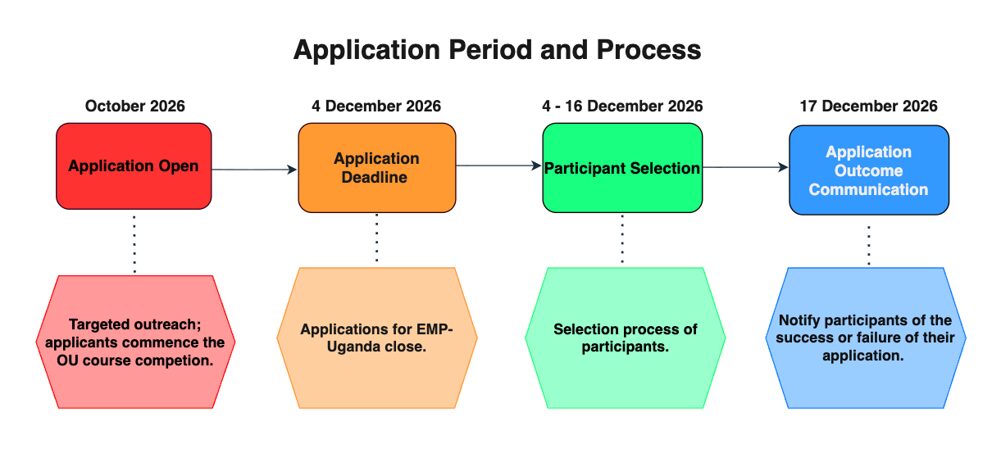
Application Period:
October 2026 to 17 December 2026
- October 2026 – Applications open. Interested individuals should start the OU course to complete it before the application deadline.
- 4 December 2026 – Application deadline at 12pm GMT.
- 17 December 2026 – Participants are notified of whether their application was successful or not.
Training Period
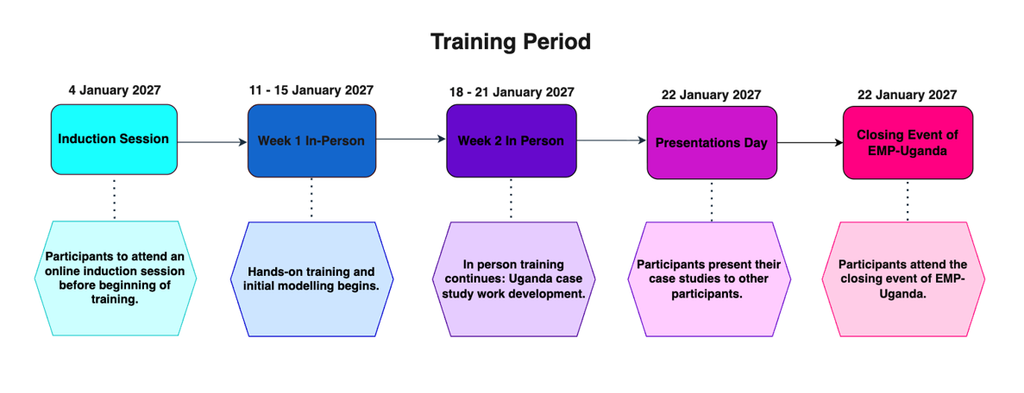
The courses are split into two parts:
Self-paced study: You complete an OU course of your choice and attach the certificate of completion.
In-depth hands-on training: In-person interactive training with dedicated trainers. The coaching will help you develop a national case study, which you will then present as an ‘elevator pitch’.
- Induction session, 4 January 2027
Online - Week 1 of training, 11–15 January 2027
Hands-on training and initial modelling begins in-person - Week 2 of training, 18–31 January 2027
Case study and presentations development - Presentation Day, 22 January 2027
Participants present their case studies to fellow participants
Application Form
***Please follow this link to apply. [opens in new tab]***
Please note, you will need to submit all the required documents for your application to be successful. Applicants will need a relatively new computer (with at least 8 GB of RAM). Some courses have additional requirements.
If you have any questions about any part of the EMP-Uganda please get in touch with EMP-Uganda Inquiries.
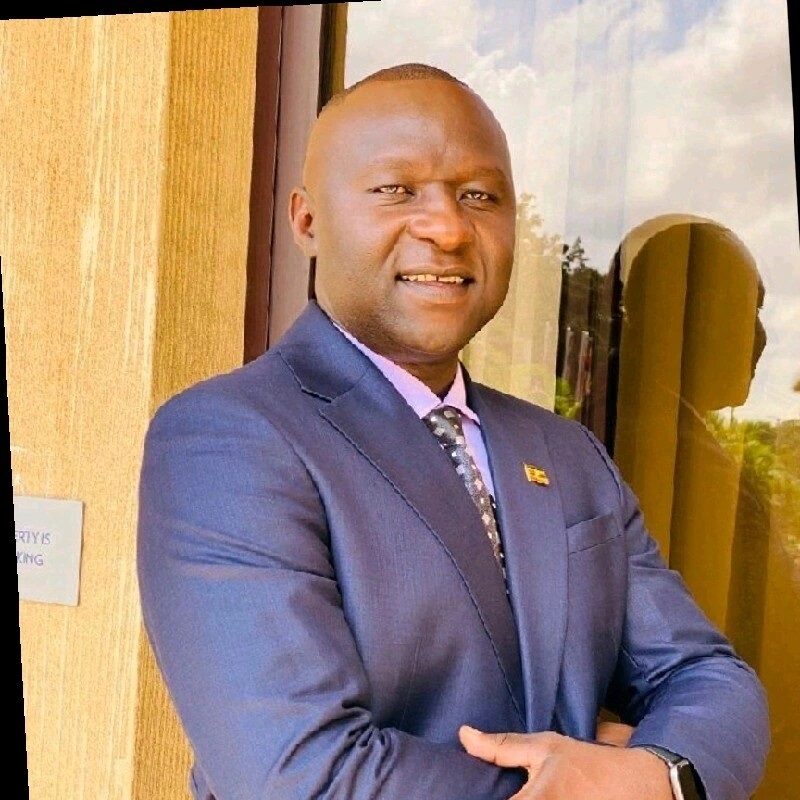
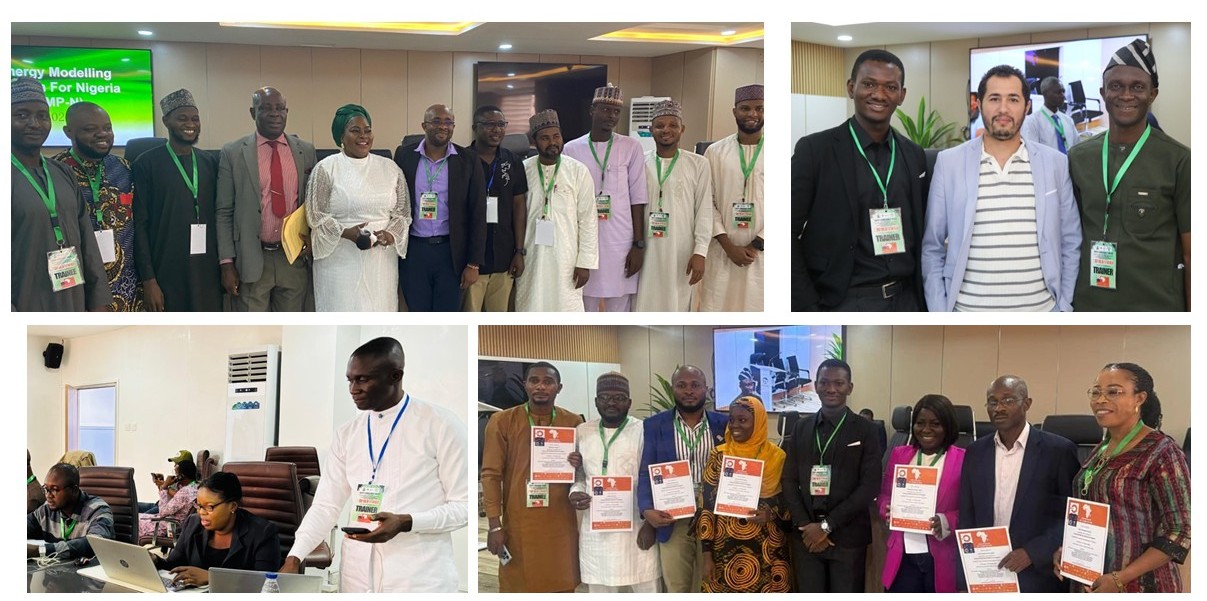
Benard Musekese Wabukala (left) is an alumnus of a previous (online) Energy Modelling Programme – one of the very first CCG delivered.
He says “What OSeMOSYS and these open-source tools have created for me is the ability to use any available historical information, as short as a single year, to simulate what we are likely to have next year and long into the future. That flexibility to really use these models and go beyond what historical information you have is a real benefit. You can develop scenarios and pathways that you would have not managed with other deterministic approaches that we are used to.”
You can read an interview with Benard about how he has used his training to help his university become a policy advisor to the Ugandan Government here.
Arinaitwe Prossie (right) is a Power System Engineer with the Ministry of Energy and Mineral Development, Uganda. She works mainly in the Rural Electrification Department. ‘Prossie’ followed the MAED track at the EMP-G in Trieste in September 2024.
She commented: “Initially, a friend shared the link and I engaged my government. They were interested in the energy modelling training and recommended me to CCG for funding. Some of my colleagues had already done the training in other tracks.
It’s been an interesting experience because, for so many years, we’ve been modelling demand based on manual tools. This was the first time I’ve had a software tool for estimating the actual demand, especially for the industrial sector.”
Read our interview with Prossie here.

Partners
In alphabetical order:
- 2050 Pathways Platform
- British High Commission
- Centre for Global Equality
- Centre for Research in Energy and Energy Conservation (CREEC)
- Centre for Sustainable Transitions: Energy, Environment and Research (STEER), Loughborough University
- Clean Cooking Alliance
- Climate Compatible Growth Programme (#CCG)
- Energy Sector Management Assitance Program (ESMAP)
- Global Green Growth Institute
- Global Research and Technology Development
- Green Grids Initiative (GGI)
- Imperial College London
- International Atomic Energy Agency
- International Energy Agency
- Kartoza
- KTH Royal University of Stockholm
- Ministry of Energy and Mineral Development (MEMD)
- Modern Energy Cooking Services (MECS)
- OpTIMUS Community
- Politecnico di Milano
- Simon Fraser University (SFU)
- Sustainable Energy for All
- United Nations Department of Economic and Social Affairs (UNDESA)
- United Nations Development Programme (UNDP)
- United Nations Economic Commission for Africa (UNECA)
- University of Cambridge
- University of Oxford
- World Bank
- World Resources Institute (WRI)