The Energy Modelling Platform – Zambia (EMP-Zambia) is a country specific EMP hosted by the Centre for Climate Research and Advisory Services (CCRAS). This will be the first EMP-Zambia.
Through hands-on training in open-source modelling and geospatial tools, participants of EMP-Zambia from government, utilities, academia, NGOs, and the private sector, among others, will learn how to apply cutting-edge, open-source modelling tools to real Zambian case studies in order to develop evidence-based solutions to Zambia’s energy transition.
The main objective of EMP-X Zambia 2027 is to strengthen the technical and institutional capacity of selected participants in Zambia to apply energy modelling and geospatial decision-support tools for evidence-based energy planning, scenario development, and investment decision-making. This will be done by building competence in three specialised tools (CLEWs, FINPLAN, and MAED) for understanding the climate–water–energy nexus, financial planning analysis and energy-demand assessment, respectively.
The EMP also aims to strengthen institutional collaboration and establish a sustained community of practice among government, academia, utilities and regulators, development partners, private-sector actors, and other energy practitioners.
There is no fee to attend; however competition for spaces is high.
EMP-Zambia 2027 will take place 8–19 February 2027 and is an in-person event taking place in Lusaka.
The full concept note is available here
There are three courses available as part of this EMP. See below for details.
Available Courses
As part of the application, you will need to complete the Open University course for the tool you wish to be trained in.
For example: if you would like to apply for MAED, you would need to complete the course on the Open University website for MAED.
Once completed, you will receive a certificate from the Open University. The certificate must be attached to your application form.
All the courses are available free via the Open University (OU) [Links open in a new tab].
- Introduction to CLEWs [OU Link]
Climate, land-use, energy, and water systems (CLEWs) models are tools for simultaneous consideration of food, energy, and water security. They are designed to assess how production and use of these resources may contribute to climate change, and how climate change may affect resource systems. By comparing different technologies and value chains, participants will use the CLEWs model to identify pressure points and indicate synergies and trade-offs to reach development goals. - MAED [OU Link]
- This course will strengthen participants’ ability to use the Model for Analysis of Energy Demand (MAED) for long-term energy-demand analysis and projection using demographic, socio-economic, technological, and sectoral drivers. Participants will develop demand scenarios that can support generation, infrastructure, and broader energy-system planning.
- FINPLAN [OU Link]
The FINPLAN model (Model for Financial Analysis of Electric Sector Expansion Plans) is a technology-neutral financial planning tool developed by the International Atomic Energy Agency (IAEA) to evaluate the financial viability and risk of power projects and electricity expansion plans over their lifetime. By using this tool, participants will compare construction and operating costs against funding sources and financing terms to generate cash flows, balance sheets, and financial indicators.
How to Apply
When you complete your application – USING THE LINK AT THE BOTTOM OF THIS PAGE – you must attach the following:
- A certificate of completion for the respective Open University course
- A certificate of completion for ‘Applied Political Economy Analysis for Energy Modelling‘, a free Open University course. [all applicants]
- A stamped Letter of Commitment from the your institution, which stipulates an express statement from your institution towards attendance for the module of choice. This letter must demonstrate that the output of your study is in demand by government/is policy-relevant research or that the skills you acquire will be used in university teaching/government planning.
- A Letter of Motivation in which you state why you should be selected for the course, and why your background knowledge and experience makes you ideal for the course.
Additionally, candidates may be required to complete additional learning before the course. This will communicated by CCG and the track trainers prior to the training.
Application Period:
October 2026 to 17 December 2026
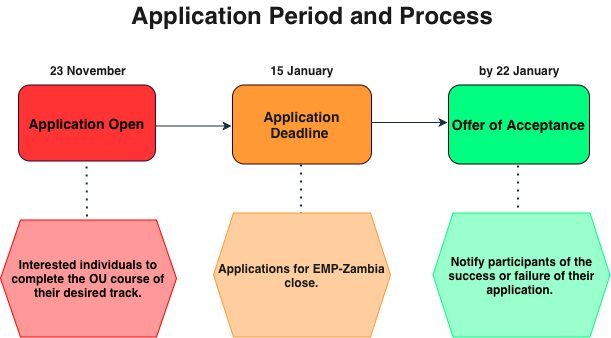
- 23 November 2026 – Applications open. Interested individuals should start the OU course to complete it before the application deadline.
- 15 January 2026 – Application deadline at 12pm GMT.
- 22 January 2026 – Participants are notified of whether their application was successful or not.
Training Period
The courses are split into two parts:
Self-paced study: You complete an OU course of your choice and attach the certificate of completion to your application.
In-depth hands-on training: In-person interactive training with dedicated trainers. The coaching will help you develop a national case study, which you will then present as an ‘elevator pitch’.
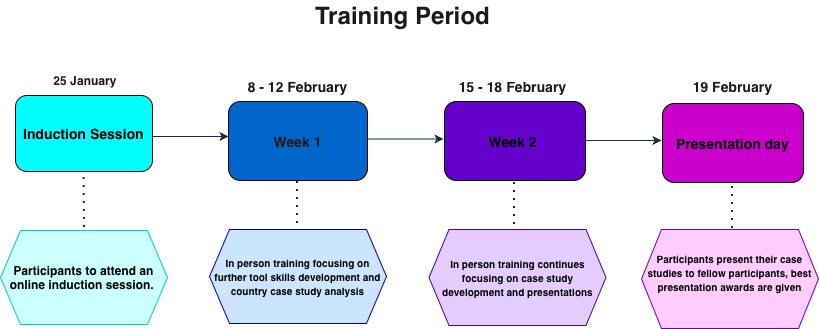
- Induction session, 25 January 2027
Online - Week 1 of training, 8–12 February 2027
Hands-on training and initial modelling begins in-person - Week 2 of training, 15–18 February 2027
Case study and presentations development - Presentation Day, 19 February 2027
Participants present their case studies to fellow participants
Application Form
***Please follow this link to apply. [opens in new tab]***
Please note, you will need to submit all the required documents for your application to be successful. Applicants will need a relatively new computer (with at least 8 GB of RAM). Some courses have additional requirements.
If you have any questions about any part of the EMP-Zambia please get in touch with EMP-Zambia Inquiries.
Key Partners
In alphabetical order:
- British High Commission Lusaka
- Climate Compatible Growth Programme (CCG)
- University of Zambia