This is the second Energy Modelling Platform for Asia and the Pacific (EMP-APAC) and the fifteenth EMP event globally. Nearly all Asia-Pacific countries have included renewable power generation in their Nationally Determined Contributions (NDCs) to climate action under the Paris Agreement. This focus, combined with the region’s abundant renewable resources (such as wind and solar), and the urgent need to mobilise investments to support sustainable growth, means that strategic assessment and planning are absolutely vital. Using country-specific data and open-source energy modelling tools provides the factual basis for these assessments. The EMP will give you the skills you need to do this, and train a new generation of energy modellers in the Asia-Pacific Region
There is no fee to attend; however, competition for places is high. Funding for some in-person participants is also available for flights and/or accommodation.
Although EMP-APAC acknowledges that different countries and regions within Asia-Pacific will require context-specific approaches, the overarching objectives of the platform are to:
- Gather the energy planning and modelling community in Asia-Pacific to share experiences, models, and data in climate, land, energy, and water systems.
- Support human and institutional capacity in Asia-Pacific for integrated energy modelling and investment planning.
- Support the development of centres of excellence for energy planning in Asia-Pacific.
- Promote efficient and widespread use of (cost free) open-source modelling tools to support the implementation of the SDGs, the Paris Agreement, and Asian Development Bank’s Vision 2030
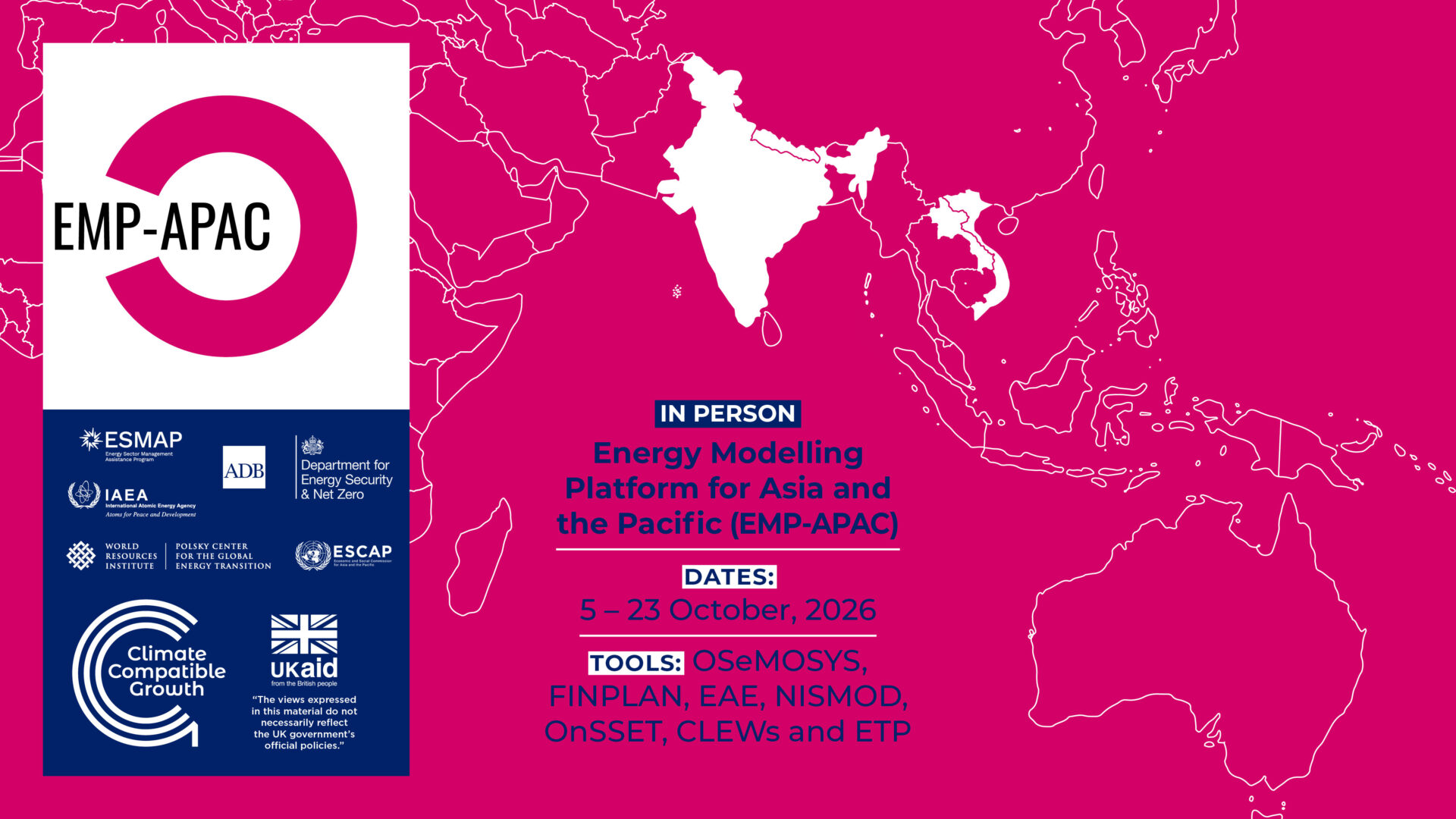
EMP-APAC 2026 will take place 5–23 October 2026 and is an in-person event (the first week is online only), taking place at the United Nations Economic and Social Commission for Asia and the Pacific in Bangkok, Thailand. The event is organised jointly by CCG, United Nations Economic and Social Commission for Asia and the Pacific, the Asian Development Bank, the World Bank (specifically the Energy Sector Assistance and Management Program), the International Atomic Energy Agency, the World Resources Institute, and the Department of Energy Security and Net Zero, and the OpTIMUS Community.
The full concept note is available to download here
There are now seven courses available as part of this EMP.
- Energy System Modelling using Modelling User Interface for OSeMOSYS (MUIO)
- FINPLAN (Financial Planning of Energy Infrastructure) and Investment Pipelines
- Introduction to CLEWS: Climate, Land-Use, Energy and Water Systems
- OnSSET / The Global Electrification Platform
- Infrastructure and Climate Resilience [NISMOD] Climate Resilience
- Energy Access Explorer: Data–driven, Integrated and Inclusive Energy Planning
- Electricity Transition Playbook*
How to Apply
As part of the application, you will need to complete the Open University course for the tool you wish to be trained in.
For example: if you would like to apply for FINPLAN, you would need to complete the course on the Open University website for FINPLAN.
Once completed, you will receive a certificate from the Open University. The certificate must be attached to your application form.
All the courses are available free via the Open University (OU) [Links open in a new tab].
Application Period
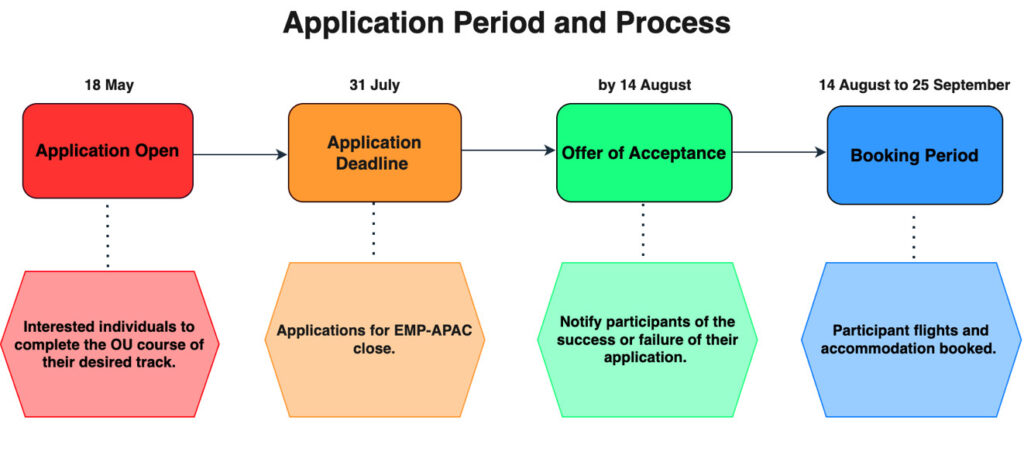
- 18 May 2026 – Applications open. Interested individuals should start the OU course to complete it before the application deadline
- 31 July 2026 – Application deadline at 12pm GMT.
- 14 August 2026 – You will be notified whether your application was successful or not
- 14 August to 25 September 2026 – Participant flights and accommodation are booked and visa letters are sent.
Required Documents
When you complete your application – USING THE LINK AT THE BOTTOM OF THIS PAGE – you must attach the following:
- A certificate of completion for the respective Open University course
- A certificate of completion for ‘Applied Political Economy Analysis for Energy Modelling‘, a free Open University course. [all applicants]
- A stamped Letter of Commitment, including an explicit statement from your institution that you will attend fully and naming the module of choice. This letter must demonstrate that the output of your study is in demand by government/is policy-relevant research or that the skills you acquire will be used in university teaching/government planning. This requires a letter from a head of unit (government)/academic department. See the concept note for details. [All applicants]
- A Letter of Motivation in which you state why you should be selected for the course, and why your background knowledge and experience makes you ideal for the course.
Training Period
The courses are split into two parts:
Self-paced study: You complete an OU course of your choice and attach the certificate of completion. Once accepted and on the EMP-APAC, there is an induction session followed by Week 1 which is conducted online.
In-depth hands-on training: Weeks 2 and 3 (12–23 October) is in-person, interactive, and with dedicated trainers*. The coaching will help you develop a national case study, which you will then present as an ‘elevator pitch’ to a senior decision-maker.
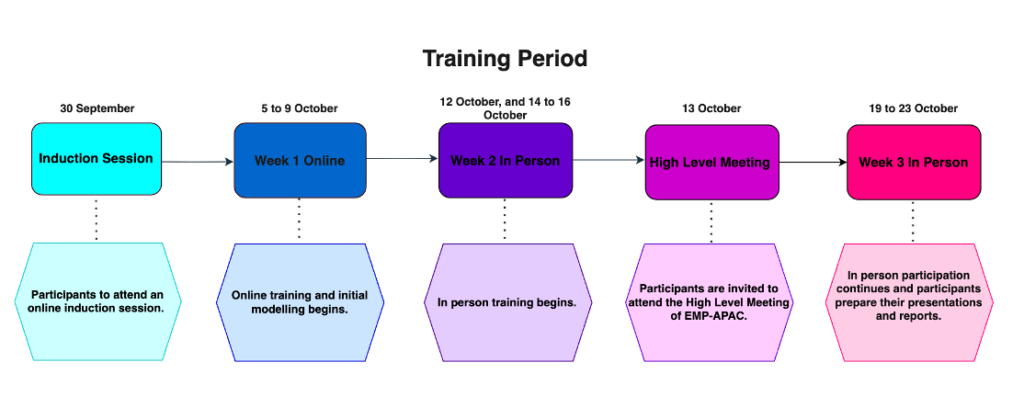
- Induction Session, 30 September, online
Information about how the event should be approached and the importance of modelling and its applications. - Week 1 of training, 5–8 October, online
Online training and initial modelling begins - Week 2 of training, 12 & 14–16 October, in-person
In-person training begins - High-level meeting, 13 October, in-person
Strategic dialogue with government officials, international organisations, and planning and policy experts - Week 3 of training, 19–23 October, in-person*
Training concludes with presentations and reports
* Note: the Electricity Transition Playbook course is an in-person course lasting one week only, and will take place during week 3 of the training.
Application Form
***Please follow this link to apply. [opens in new tab]***
Please note, you will need to submit all the required documents for your application to be successful. You will need to have stable internet access to participate in training, and a relatively new computer (with at least 8 GB of RAM). Some courses have additional requirement (see concept note).
If you have any questions about any part of the EMP-APAC please get in touch with OpTIMUS Inquiries.
Partners
In alphabetical order:
- Asian Development Bank (ADB)
- Clean Cooking Alliance
- Climate Compatible Growth Programme (#CCG)
- Department of Energy Security and Net Zero (DESNZ)
- Deutsche Gesellschaft für Internationale Zusammenarbeit (GIZ)
- United Nations Economic and Social Commission for Asia and the Pacific (UNESCAP)
- Energy Sector Management Assistance Program (ESMAP)
- Green Grids Initiative (GGI)
- International Atomic Energy Agency (IAEA)
- International Renewable Energy Agency (IRENA)
- Imperial College London (ICL)
- Kartoza
- KTH Royal Institute of Technology (KTH)
- OpTIMUS Community of Practice
- Open University (OU)
- Politecnico Di Milano
- Simon Fraser University
- Sustainable Energy for All (SEforALL)
- The Loughborough Centre for Sustainable Transitions: Energy, Environment, and Resilience (STEER)
- United Kingdom Foreign, Commonwealth and Development Office (UK FCDO)
- United Nations Economic Commission for Africa
- United Nations Department of Economic and Social Affairs (UNDESA)
- United Nations Development Programme (UNDP)
- University of Cambridge – Centre for Global Equality
- University of Oxford
- World Resources Institute (WRI)
- World Bank Group (WBG)
- 2050 Pathways Platform