This is the fifth round of the Energy Modelling Platform for Latin America and the Caribbean (EMP-LAC), which started in 2022 and aims to transfer skills in models and tools for energy planning needs.
The overarching objectives of the EMP-LAC platform are to:
- Gather the energy planning and modelling community in Latin America and the Caribbean to share experiences, models, and data in climate, land, energy, and water systems.
- Support human and institutional capacity in Latin America and the Caribbean for integrated energy modelling and investment planning.
- Support the development of centres of excellence for energy planning in Latin America and the Caribbean
- Promote efficient and widespread use of (cost free) open-source modelling tools to support the implementation of the SDGs and the Paris Agreement
There is no fee to attend; however, competition for space is high, and places are limited. Funding will also be provided for accommodation, travel, and lunch for select candidates.
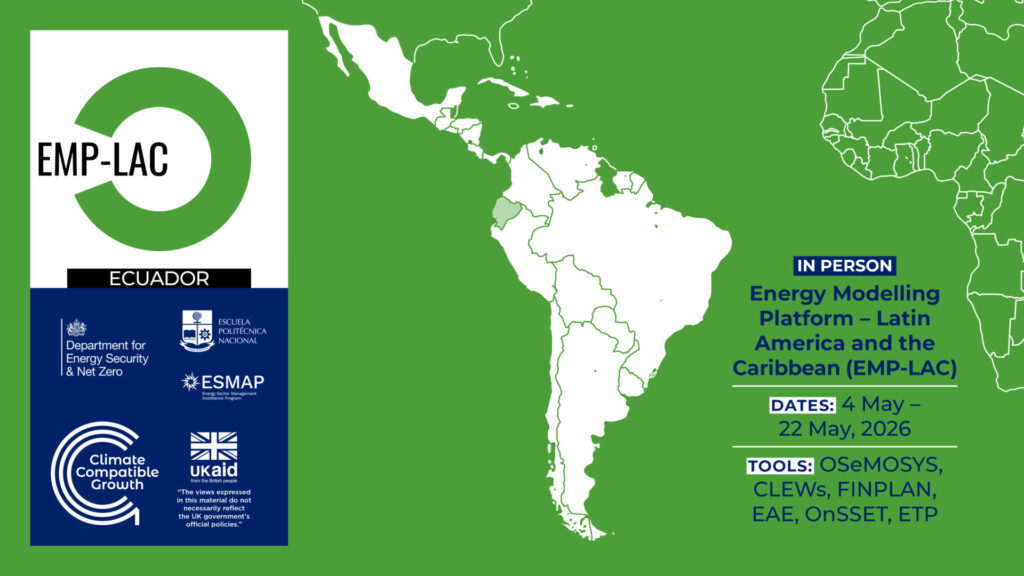
EMP-LAC 2026 will take place from 4–8 May (online) and 11–22 May in-person at Escuela Politécnica Nacional (EPN), Quito, Ecuador.
The full concept note is available for download here.
There are six courses available as part of this EMP. See below for details.
How to Apply
All applications require you to complete the Open University course for the tool you wish to be trained in, along with completion of the ‘Modelling, policy and political economy‘ course. For example: if you would like to apply for MAED, you would need to complete the course on the Open University website for MAED.
Once completed, you will receive a certificate from the Open University. The certificate must be attached to your application form.
Courses
All the courses are available free via the Open University (OU) [Links open in a new tab].
- Electricity Transition Playbook*
- Energy System Modelling using the Modelling User Interface for OSeMOSYS (MUIO)
- FINPLAN (Financial Planning of Energy Infrastructure) and Investment Pipelines
- Introduction to CLEWS: Climate, Land-Use, Energy and Water Systems
- OnSSET/The Global Electrification Platform
- Spatial Data Management and Analytics for Integrated Energy Planning (Energy Access Explorer)
Application Period:
26 January to 25 March 2026
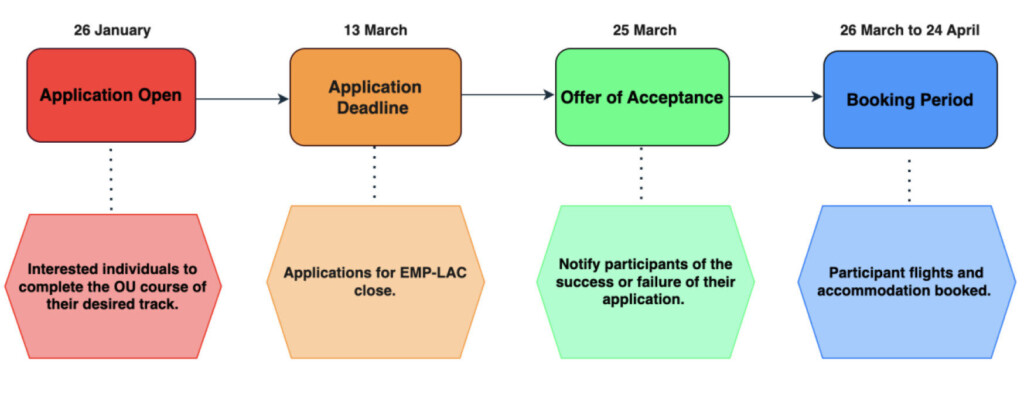
- 26 January 2026 – Applications open. Interested individuals should start the OU course to complete it before the application deadline.
- 13 March 2026 – Application deadline at 12pm GMT-5.
- 25 March 2026 – Participants are notified of whether their application was successful or not. Unsuccessful applicants may still be considered for online participation.
- 26 March to 24 April 2026 – Participant flights and accommodation are booked. Please note, full-time commitment at training sessions is required.
Training Period
29 April to 22 May 2026
The courses are split into two parts:
Self-paced study: You complete an OU course of your choice and attach the certificate of completion. Week 1 of the course provides online coaching and troubleshooting to further modelling knowledge.
In-depth hands-on training: In-person interactive training with dedicated trainers. The coaching will help you develop a national case study, which you will then present as an ‘elevator pitch’ to a senior decision-maker.
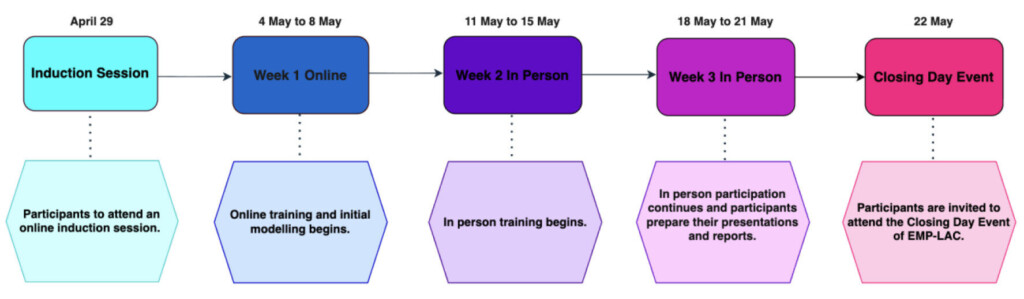
- Induction session (online) [29 April]
- Week 1 of training (online): 4–8 May
Training and initial modelling begins - Week 2 of training (in-person): 11–15 May
Training and modelling continues in-person - Week 3 (in-person) 18–21 May
Participants prepare presentations and reports - Closing Day Event (22 May)
Participants are invited to attend a closing day event (details tbc)
*Please note that the Electricity Transition Playbook course only takes place during Week 3: 18–21 May
Application Form
***Please follow this link to select your application type and apply. [opens in new tab]***
All the required documentation (Open University certificates, stamped Letter of Commitment, and Letter of Motivation) is stated in the concept note and application form. Please ensure you read this carefully in advance and submit all necessary material. If you have any questions regarding what you need to submit, please email OpTIMUS Inquiries.
Applicants will need a relatively new computer (with at least 8 GB of RAM) and a stable internet connection in instances if online participation is accepted. Some courses have additional requirements [CLEWS – Windows 10; MUIO – Windows 10 or later and MS Office].
Funding
Funding will be made available for some in-person participants to cover the cost of travel, accommodation, and lunch. However, participants not selected for funding can still attend at their own expense or can be funded by other organisations. Please specify in your application if you wish to be considered for funding. In certain instances, subject to funding and co-funding, some tracks may be held online.
Contact
If you have any questions about any part of the EMP-LAC please get in touch with OpTIMUS Inquiries.
Partners
In alphabetical order:
- Climate Compatible Growth Programme (#CCG)
- Energy Sector Management Assistance Program (ESMAP)
- Escuela Politécnica Nacional (EPN)
- Green Grids Initiative
- International Atomic Energy Agency (IAEA)
- International Renewable Energy Agency (IRENA)
- Imperial College London (ICL)
- KTH Royal Institute of Technology (KTH)
- OpTIMUS Community of Practice
- Politecnico di Milano
- Simon Fraser University
- Sustainable Energy for All (SEforALL)
- The Loughborough Centre for Sustainable Transitions: Energy, Environment, and Resilience (STEER)
- United Kingdom Foreign, Commonwealth and Development Office (UK FCDO)
- United Nations Department of Economic and Social Affairs (UNDESA)
- United Nations Development Programme (UNDP)
- University of Cambridge
- University of Costa Rica
- University of Oxford
- World Bank Group (WBG)
- World Resource Institute
- 2050 Pathways Platform